

By : Chinasaokwu Helen Okoro
A ‘Lesser Evil’ and a Promise of Amnesty: Gumi’s New Controversial Pitch on Nnamdi Kanu Sparks National Debate
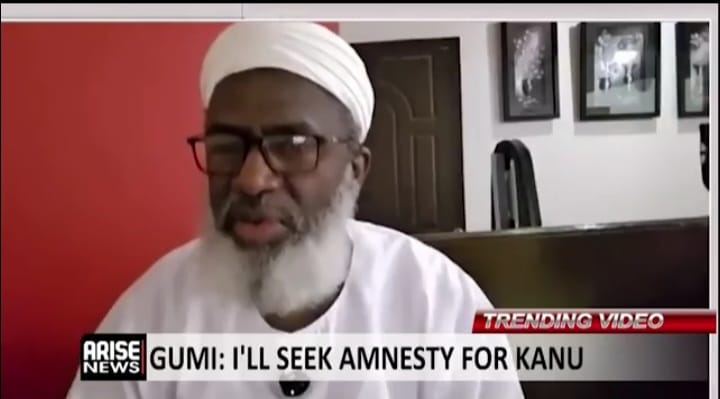
Controversial Islamic cleric, Sheikh Ahmad Gumi, has once again stepped into the heart of Nigeria’s political and moral storm, declaring that he is ready to personally lead an amnesty campaign for the detained leader of the Indigenous People of Biafra (IPOB), Nnamdi Kanu—on one condition: that Kanu shows remorse.
Gumi, known for his outspoken views on insecurity and negotiations with armed groups, made the comments amid the resurfacing of a 2021 BBC interview in which he described the kidnapping of school children as a “lesser evil” compared to armed militants who raid communities to kill innocent civilians. The remark triggered fresh outrage, reopening old wounds from some of Nigeria’s darkest security moments.
Speaking during a public lecture in Kaduna, the cleric said that his stand on Nnamdi Kanu is rooted in what he called the “principle of national healing.” According to him, if the government could negotiate with bandits in the past, then dialogue should not be off the table when it comes to resolving the deepening grievances surrounding the IPOB leader.
“Every conflict has an entry point and an exit point,” Gumi said. “If Nnamdi Kanu is ready to show remorse and embrace peace, I am ready to lead the call for his amnesty. Nigeria must not be afraid of reconciliation.”
His comment immediately ignited reactions across social media, with many questioning the cleric’s moral authority to speak on matters of peace, given his past controversial statements. Critics argue that his remarks on kidnapping—especially against the backdrop of repeated mass abductions of schoolchildren—make him an unsuitable advocate for national dialogue.
In the resurfaced 2021 interview, Gumi was heard saying that, when compared to terrorist groups who invade towns and massacre residents, bandits who abduct school children commit a “lesser evil.” Though he insisted that his comments were taken out of context, Nigerians continue to associate him with a soft approach toward violent criminal groups.
Security experts argue that the cleric’s viewpoint undermines the gravity of kidnapping, which has left thousands of families devastated. “There is no ‘lesser evil’ when children are taken from their classrooms,” said Abuja-based analyst Sarah Eze. “Whether it is done for ransom, ideology, or to instill fear, trauma is trauma. Criminality is criminality.”
Supporters of Gumi, however, say he has long advocated for dialogue as a means of ending insecurity, insisting that he is misunderstood. They argue that his willingness to negotiate, where others prefer force, shows courage rather than complicity. To them, his call for amnesty for Kanu is a logical extension of his philosophy that Nigeria needs negotiation, not endless confrontation.
The IPOB leader remains in government custody after a series of court cases and legal battles that have polarized Nigeria along ethnic and political lines. Calls for his release have come from political figures, human rights groups, and traditional leaders who believe freeing him could ease tensions in the southeast.
But Gumi’s involvement complicates the issue. Many Nigerians see him as a polarizing figure whose comments often provoke more controversy than calm. For them, his offer to mediate on behalf of Kanu is a distraction rather than a solution.
In the southeast, some activists welcomed the cleric’s statement, saying that anyone who can push the government toward dialogue should be heard. But others questioned why Gumi’s support appears conditional, arguing that justice for Kanu should not hinge on a subjective measure of “remorse.”
As the debate continues, one thing is clear: Gumi’s voice, whether welcomed or rejected, has once again thrust itself into Nigeria’s national conversation. His remarks highlight the deep fractures in the country’s security landscape, where kidnapping, terrorism, and separatist tensions collide in a complex web of pain and politics.
For now, his promise to seek amnesty for Nnamdi Kanu remains just that—a promise. But in a nation hungry for peace and wary of controversy, even words can ignite a storm.

About The Author

 BIAFRA, KANU, AND NIGERIA’S CROSSROADS: UKACHUKWU OKORIE SPEAKS IN CANDID INTERVIEW WITH IRODILI
  Nigeria :Tinubu’s Ambassadorial Nominees List Not a Good Representation of the Country – Keshi
  76ers set record with 15th consecutive win
  No, Facebook doesn’t secretly listen via your microphone
  LabCorp hit with federal suit over robocalls
  MARAN to unveil landmark publication honouring drivers of Nigeria’s blue economy
  Drama Erupts Online as 2Baba and Wife Natasha Clash on Instagram Live Amid UK Arrest Rumour
  Nigeria’s Defence Minister Badaru Steps Down Amid Security Emergency