

By: Chioma Madonna Ndukwu
Ouattara Wins Fourth Term In Ivory Coast Amid Boycott, Low Turnout
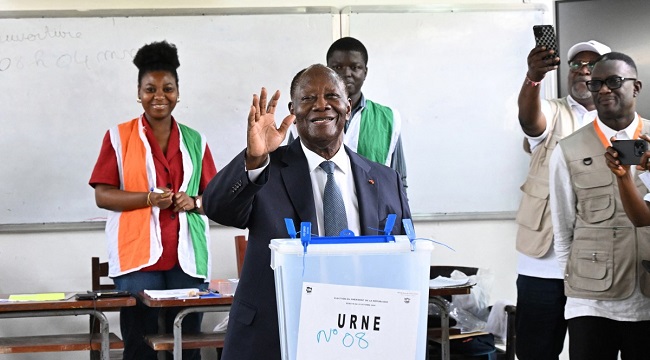
Ivory Coast’s President Alassane Ouattara has secured a fourth term in office, claiming a sweeping 89.77 percent of the vote in a presidential election largely boycotted by major opposition figures and marred by political tension.
The Independent Electoral Commission announced the results on Monday, noting a 50.1 percent voter turnout, roughly the same as in the 2020 poll that Ouattara also won by a landslide. Entrepreneur Jean-Louis Billon came a distant second with just over three percent of the vote.
Ouattara, 83, ran under the banner of the ruling Rally of Houphouëtists for Democracy and Peace (RHDP). He was widely expected to win after two of his strongest opponents—former president Laurent Gbagbo and ex-Credit Suisse CEO Tidjane Thiam, were barred from contesting.
Gbagbo was disqualified due to a criminal conviction, while Thiam was excluded for holding dual French nationality.
The election followed weeks of unrest across the cocoa-producing nation, where clashes between protesters and security forces left at least eight people dead and dozens injured. Opposition parties had urged their supporters to boycott the polls, describing them as unfair and lacking credibility.
In several regions, including Gbagbo’s southern stronghold of Gagnoa, turnout was reportedly as low as 20 percent.
Analysts say this reflects deep divisions within the electorate and disillusionment among opposition supporters.
Political researcher William Assanvo from the Institute for Security Studies said, “The absence of major opposition figures and calls for non-participation contributed significantly to voter apathy.”
This election marks another chapter in Ivory Coast’s turbulent democratic history. Ouattara first assumed power in 2011 after a disputed election triggered a violent conflict that claimed more than 3,000 lives.
Since then, the West African nation has enjoyed relative stability, though political competition remains fraught with tension and mistrust.
The president’s decision to seek a fourth term reignited debates over constitutional limits and political renewal.
While supporters view him as a guarantor of stability and economic growth, critics accuse him of entrenching one-party dominance and shrinking democratic space.
In Abidjan, the capital, pro-government newspaper Le Patriote celebrated what it called “a calm election,” while opposition daily Notre Voie described the outcome as “a reflection of a divided country.”
Despite concerns from the opposition, Abidjan returned to normal activity on Monday, following a weekend of heightened security and restricted movement.
Ouattara’s party hailed the result as a validation of his leadership. But opposition leaders have rejected the outcome, calling for fresh elections under what they describe as “truly democratic conditions.”
Ivory Coast’s political future now hinges on whether Ouattara can bridge growing national divisions and reassure a weary electorate that peace and inclusion will define his final term in office.
About The Author







Leave a comment