

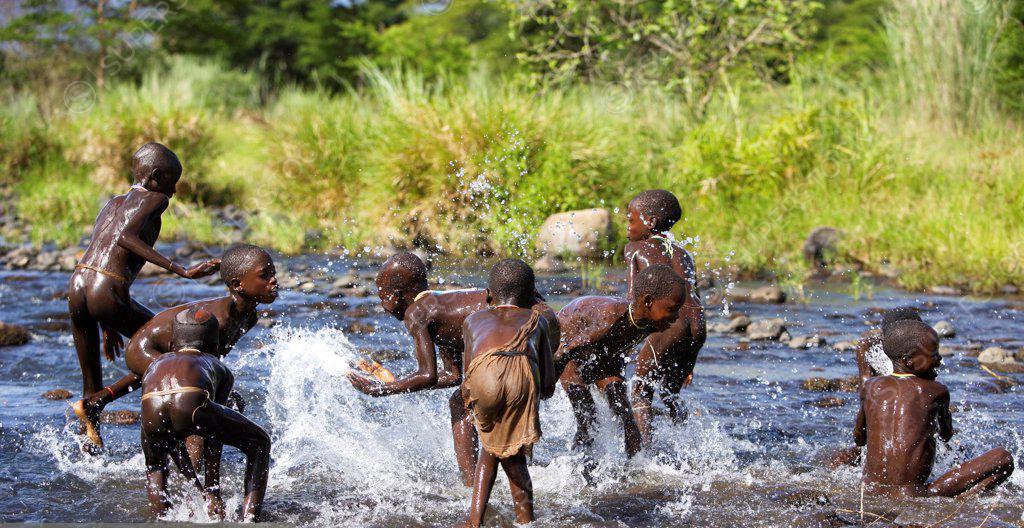
Africa’s Talking Drum: The River Where Children Stopped Answering Their Names
In the land beyond the red hills, there was a river that once carried children’s laughter more often than water sound.
Villages used it as a shortcut to the market, and mothers used it as a measuring line for return times. Old hunters said the river had no owner.
But everyone knew it had watchers.
One season, the river changed its habit. It did not roar. It did not flood. It simply began to take names and return silence. The first incident was spoken about in whispers.
A group of children had crossed in the morning, uniforms still smelling of soap and sun.
By evening, only one slipper was found near the bank.
Then came another crossing. And another silence. People stopped calling it by its name and started calling it “the road that answers nothing.”
In the village, fear learned to sit at dinner tables.
Mothers began counting children before the sun fully rose. Fathers began walking longer distances home, as if distance could delay fate.
Yet the most painful part was not the river. It was the silence beyond it. The hunters went to the chief’s compound. “Something is living on that path,” one said.
The chief nodded slowly, the way people nod when they want time to look like action. “We are aware,” he replied.
Days passed. Then weeks. No patrols returned with answers. Only rumours returned with weight.
Some said strangers had built invisible camps near the forest. Some said the river itself had learned greed. Some said the land was simply forgetting its children.
Each version grew louder than truth. But no voice from above grew louder than fear.
One morning, an old tortoise sat near the riverbank watching the water move like it had nothing to confess. A young goat approached him. “Why does no one stop it?” the goat asked.
The tortoise did not answer immediately. He watched the far side of the river where paths disappeared into bush.
Then he said quietly, “When those who should call the name of danger begin to speak softly, danger learns to speak loudly.”
The goat looked confused. “But the chief knows. The tortoise nodded. “That is the most dangerous part.”
Across the river, life continued in another form.
Markets still opened. Drums still sounded. Leaders still gathered under trees to discuss smaller things with larger confidence. But the river kept its own record.
And every time silence met violence without resistance, the river remembered another name it would not return.
Eventually, people stopped letting children cross alone. Then they stopped letting them cross at all.
The market across the river began to die slowly, not from attack, but from absence. And the village learned something it did not want to name.
That insecurity does not always announce itself with noise. Sometimes it grows inside leadership silence until the people themselves begin to shrink their own world to survive it.
MORAL:
When leadership stays silent in the face of danger, fear does not disappear—it spreads responsibility onto the people until they begin to live smaller lives.
ENGAGEMENT HOOK:
When leaders fail to speak or act during insecurity, who truly carries the burden, the government, or the people forced to adapt?
About The Author















Leave a comment