Home News Agriculture Ghana: With no help in sight, Ghana’s coastal farmers are drowning in salt.
Agriculture

Ghana: With no help in sight, Ghana’s coastal farmers are drowning in salt.

Share
Share

By Chinasaokwu Helen Okoro

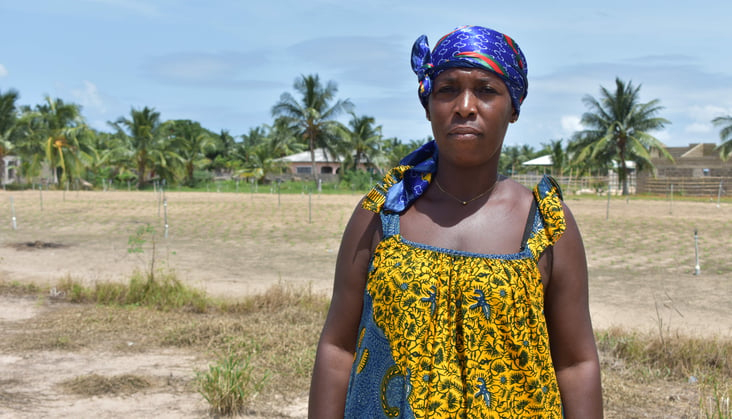
Pulitzer CentreVicentia Ayee Ayorkor looks concerned as she examines a handful of carrots she pulled out of the ground. They’re too small. She is afraid they won’t sell well at the market, but she’s got a field full of them, so she keeps harvesting the scrawny vegetables by hand, the Ghanaian sun beating on her back.Ayorkor knows exactly what the problem is. “The salt is disturbing the farm,” says the 40-year-old smallholder farmer. Her family’s land has been inundated with saline water.

In high concentrations, salinity prevents crops from growing or considerably reduces their yield, as with Ayorkor’s carrots.She is one of thousands of farmers losing crops and income to soil salinity in the Volta Delta region on Ghana’s southeast coast.

Her land is sandwiched between the Gulf of Guinea and Keta Lagoon, two saltwater bodies that infiltrate the groundwater used for irrigation from below and flood the surface during storm surges that are increasing in frequency because of climate change.No agriculture extension officers.

Although researchers and some government officials have been calling for more action to address rising salinity and its ruinous effects for years, farmers in this area who spoke to The Africa Report say they’ve had no help, and local agriculture officials note that their hands are tied by lack of support from central government.“Nobody even cares about what we are doing. Not agriculture [extension] officers,” says Angela Avetey, a neighbour of Ayorkor’s and fellow farmer, referring to the local district officials who support farmers directly.

“Nobody comes, so we always teach ourselves. You experience something, you tell your neighbour, your farm colleague, [that] this is what is happening. We need help.”Ghana unlikely to achieve food self-sufficiency target in 2024.

Agriculture director Godwin Tettey in Keta Municipal District, where Ayorkor and Avetey live, does not dispute that growers aren’t getting support. “We are understaffed,” Tettey says, adding that he only has four extension officers, each supposed to liaise with more than 3,000 farmers.

It’s one of a litany of problems. Tettey says that as of September, his office has not received its budget allocation for 2024 from the food and agriculture ministry, and he sometimes covers his staff salaries out of his pocket.Saline-saturated environmentNeither the ministry, nor the Keta Municipal Assembly, which Tettey says usually distributes that money, responded to a request for comment.

Other ministry decisions, he says, have been just as counterproductive. In 2017 and 2018, the ministry sent him seeds to distribute without first surveying farmers’ needs in the saline-saturated environment.They are still sitting in his warehouse because they weren’t salt-tolerant varieties.

“The farmers refused to take it because they say it doesn’t do well,” Tettey says, adding that he asked the ministry for seeds designed to withstand the salt, “but believe me, those things never came”.The district office also lacks the technical knowledge it needs to combat salinity. “We don’t have the expertise,” Tettey says. “We are not trained in that regard, so if some organisation comes and wants to collaborate, we are ready.

”There have been successful collaborations in other countries, providing a replicable model that could work here. In Bangladesh, agriculture officials have partnered with NGOs that specialise in saline agriculture supported by foreign aid to successfully train thousands of smallholder farmers to grow food even through bouts of extreme salinity.

Posted on October 7, 2024 08:20Ghanaian farmer Angela Avetey stands near a field of okra sprouts. The plants have germinated, but yellowed leaves are tell-tale signs of salt stress. (Rachel Parsons)Ghanaian farmer Angela Avetey stands near a field of okra sprouts. The plants have germinated, but yellowed leaves are tell-tale signs of salt stress. (Rachel Parsons)Salt water is killing crops.

In the runup to COP, The Africa Report looks at how it is affecting farmers in Africa – in conjunction with the Pulitzer CentreVicentia Ayee Ayorkor looks concerned as she examines a handful of carrots she pulled out of the ground. They’re too small. She is afraid they won’t sell well at the market, but she’s got a field full of them, so she keeps harvesting the scrawny vegetables by hand, the Ghanaian sun beating on her back.

About The Author

Share

Leave a comment

Leave a Reply

Your email address will not be published. Required fields are marked *

LATEST POST

Africa

Africa’s Talking Drum: Mama Nkem Left Before Her Daughter Was Ready

By: Chioma Madonna Ndukwu Africa’s Talking Drum: Mama Nkem Left Before Her Daughter Was Ready In Umuoma Village, people said that a mother’s...

Sport

Cash Reportedly Stolen From Super Falcons Players’ Hotel Rooms in Casablanca

Cash Reportedly Stolen From Super Falcons Players’ Hotel Rooms in Casablanca The Super Falcons’ preparations for the 2026 Women’s Africa Cup of Nations...

AfricaMetro

Harvard-Trained Nigerian-American Engineer Raises $7m for Robot Designed to Assist Hair Braiders A Nigerian-American engineer and Harvard graduate, Yinka Ogunbiyi, has secured $7 million in seed funding to develop a robotic device designed to make hair braiding faster and less physically demanding for professional stylists. Ogunbiyi’s company, HaloBraid, is developing what it describes as the world’s first patented braid-assist robot. The device is designed to work with hairstylists by handling some of the repetitive movements involved in knotless braiding. The funding round was led by Seven Seven Six, a venture capital firm founded by Reddit co-founder Alexis Ohanian. AlleyCorp and Bling Capital were also among the investors. The technology has already attracted significant interest, with more than 7,000 salons reportedly waiting to use the system. HaloBraid is designed as a collaborative robot, meaning it works alongside a human stylist instead of attempting to replace one. The hairstylist remains responsible for sectioning the hair, creating the initial knot and completing the final styling. The robot then assists with the repetitive weaving process down the length of the braid before the stylist returns to finish and shape the ends. According to the company, the technology could cut the time spent on some knotless braid appointments by roughly half, allowing salons to serve more clients while reducing the physical pressure on stylists. For Ogunbiyi, the idea was born from personal experience. During the COVID-19 pandemic, she spent four days installing knotless braids on herself, an experience that made her consider how technology could assist with the most repetitive aspects of the process. She subsequently teamed up with co-founder David Afolabi to develop HaloBraid. The company’s technology is also aimed at addressing the physical demands of professional braiding. Stylists who spend years performing repetitive movements can experience problems affecting their wrists, hands, shoulders, back and joints. By assisting with the most repetitive stage of braiding, HaloBraid hopes to reduce the strain on beauty professionals and help them work more efficiently. Ogunbiyi said the technology would not take away from the personal experience of visiting a salon. Rather, she believes it can allow stylists to spend less time on repetitive movements while continuing to handle the creative and personal aspects of hairstyling. Before launching HaloBraid, Ogunbiyi worked on smart kitchen appliances and Internet of Things products. She holds a joint master’s degree in engineering and business administration from Harvard University. With a $7 million investment and thousands of salons already expressing interest, HaloBraid is seeking to introduce robotics into one of the world’s largest and most labour-intensive beauty markets.

Harvard-Trained Nigerian-American Engineer Raises $7m for Robot Designed to Assist Hair Braiders A Nigerian-American engineer and Harvard graduate, Yinka Ogunbiyi, has secured $7...

Entertainment

Days to Their Wedding, VeryDarkMan Sends Peller and Jarvis a Serious Warning

Days to Their Wedding, VeryDarkMan Sends Peller and Jarvis a Serious Warning Social media critic Martins Vincent Otse, popularly known as VeryDarkMan, has...

Sport

IOC Declines to Investigate Infantino Over Alleged Political Neutrality Breach

IOC Declines to Investigate Infantino Over Alleged Political Neutrality Breach The International Olympic Committee has refused to pursue a complaint against FIFA President...

News

IMO APC YOUTH LEAGUE INAUGURATES BOOTH WATCHDOGS, WARD CANVASSERS TO STRENGTHEN GRASSROOTS STRUCTURE AHEAD OF 2027

The Imo State Chapter of the APC Youth League on Thursday, July 23, 2026, successfully hosted its Interactive Session and Banquet at the...

Travel

VIDEO: 68 Passengers Survive Enugu Air Crash-Landing at Benin Airport

VIDEO: 68 Passengers Survive Enugu Air Crash-Landing at Benin Airport Sixty-eight passengers have escaped without reported injuries after an Enugu Air aircraft crash-landed...

News

WASTE EVACUATION DELAYS WILL SOON EASE* *– LAWMA*

*PRESS RELEASE* *WASTE EVACUATION DELAYS WILL SOON EASE* *– LAWMA* *LASG to Acquire 3,000 Compactor Trucks Within Three Years* The Lagos Waste Management...

AfricaMetro

5 Members of Same Family Found Dead Inside Abia Residence

5 Members of Same Family Found Dead Inside Abia Residence A family of five has been found dead inside their residence in Umuimo...

Africa

US Weighs Military Action in Mali as Jihadist Threat Spreads Across the Sahel

US Weighs Military Action in Mali as Jihadist Threat Spreads Across the Sahel The United States is weighing possible military action against Jama’at...

Africa

African Talking Drum: Tortoise Lost More Than His Name

By: Chioma Madonna Ndukwu African Talking Drum: Tortoise Lost More Than His Name In the old days, before the animals began keeping count...

Related Articles

GEF-SGP inaugurates solar-powered cold room in Lagos fishing community

GEF-SGP inaugurates solar-powered cold room in Lagos fishing community The Global Environment...

Bandit Extortion Leaves Northern Farmers Facing Another Uncertain Planting Season

Bandit Extortion Leaves Northern Farmers Facing Another Uncertain Planting Season For many...

AFAN in South-West decry insecurity, demand agro-rangers to protect farms

AFAN in South-West decry insecurity, demand agro-rangers to protect farms Youths in...

Rotting Cocoa, Broken Promises: Ivory Coast Farmers Stranded Without Buyers

By : Chinasaokwu Helen Okoro   Rotting Cocoa, Broken Promises: Ivory Coast...