

By: Chioma Madonna Ndukwu
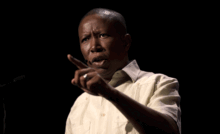
Julius Malema, President of South Africa’s Economic Freedom Fighters (EFF), has issued a powerful warning on the dangers of xenophobia, calling it one of the greatest threats to African unity and progress.
Speaking as the keynote speaker at the Nigerian Bar Association’s Annual General Conference in Enugu on Sunday, Malema said xenophobic attitudes across the continent—especially in South Africa—are not driven by migrants but by deeper issues of poverty, inequality, and failed governance.
“Xenophobia is a betrayal of African unity. It is a disease born of poverty, inequality, and government failure. Its victims are not the cause—they are fellow Africans trying to survive. Nigerians, Zimbabweans, Congolese, and Somalis are not responsible for South Africa’s economic hardship,” he said.
He criticised the continued economic dominance of multinational corporations and a white minority in South Africa, accusing them of resisting meaningful transformation and using African migrants as scapegoats.
“The real enemy is not your neighbour from another African country. The real enemy is the system that keeps the wealth of South Africa in the hands of a few, while the majority remain unemployed,” he stated.
Malema highlighted the growing presence of Nigerian companies in South Africa and South African firms operating in Nigeria, saying such economic exchanges show the potential of a unified Africa. He urged leaders to deepen integration across the continent and make cross-border opportunities more accessible.
“Africans should not be treated as foreigners on African soil. Young Nigerian engineers should be free to work in Johannesburg, and South African entrepreneurs should be able to operate in Lagos—not as outsiders, but as partners,” he said.
He warned that the continent remains stuck in a neo-coloMustang economic cycle, where raw materials are exported cheaply and returned as expensive finished goods.
“We must break this dependency. Nigeria and South Africa must industrialise together, develop together, and process our own resources here at home,” he said.
Malema called for the removal of visa restrictions between African nations, advocating for continental infrastructure, shared trade policies, and political unity.
“We don’t need visas between Nigeria and South Africa. We are one people with a shared history of colonisation and a common future. Africa must unite politically and economically,” he said.
He reiterated his vision for a single African presidency, currency, and military, saying these steps are essential to consolidating Africa’s strength in a global economy.
Malema also cautioned against reckless borrowing from institutions like the IMF and World Bank, stressing that African nations must stop relying on foreign capitals for their survival.
“Our future does not lie in Washington, London, or Beijing. It lies in African capitals—Lagos, Johannesburg, Accra, Nairobi, and Addis Ababa. We are our own liberators,” he said.
In closing, Malema urged Africans to reject internal divisions and see the value in each other.
“We are not hated just abroad—we are often not loved at home either. That must change. We must treat each other with dignity. Africa is not a dark continent. It is a continent of light, potential, and abundance,” he said.
About The Author











Leave a comment