


By: Chioma Madonna Ndukwu
When Uyo Hospital Broke Its Silence Under EFCC pressure
“Power is never quiet when it moves through spaces not built for its weight.” That thought lingers heavily over Uyo, where the calm corridors of the University of Uyo Teaching Hospital reportedly gave way to tension, accusations, and confusion after an EFCC operation linked to a disputed medical report.
In a country where institutions often speak past each other, this episode has become another uneasy reminder that procedure and perception do not always walk hand in hand.
At the centre of the storm is Prof. Eyo Ekpe, a cardiothoracic surgeon and Deputy Chairman of the Medical Advisory Committee at UUTH, who alleged that he was assaulted and dragged out of his office during the operation.
He explained that the hospital had been asked to verify a medical report tied to a suspect in a court matter, and upon review with the Head of Department, it was discovered that the doctor whose name appeared on the document was not a staff member of the hospital.
According to him, a draft response confirming the report as fake had been prepared but had not yet been formally approved when EFCC operatives arrived and later returned with armed reinforcement to effect his arrest.
The hospital management, through Prof. Ememabasi Bassey, confirmed the arrest but maintained that the document was not authentic and suggested possible internal compromise in its circulation.
The EFCC, however, tells a different story, insisting its operatives were on legitimate duty to verify a document connected to an ongoing trial and were allegedly obstructed and attacked by hospital workers.
The Commission maintains that its officers acted professionally and that the situation escalated due to resistance at the point of engagement. In its account, what unfolded was not excess, but enforcement meeting unexpected obstruction inside a sensitive environment.
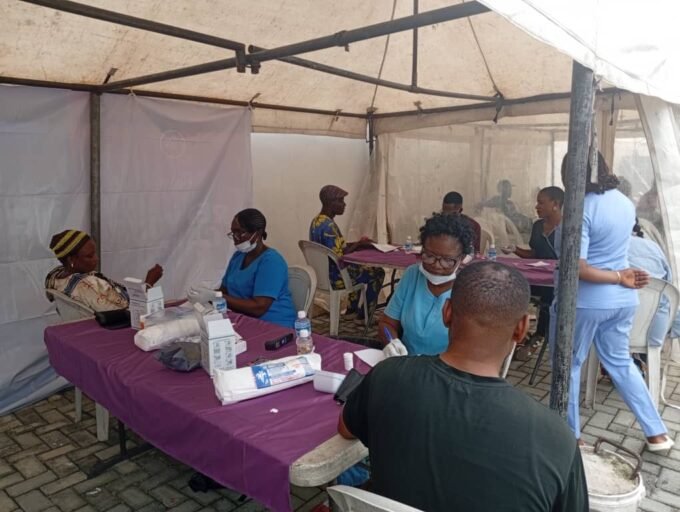
Beyond the institutional back-and-forth, the wider concern has been how quickly a hospital space designed for quiet urgency, became entangled in confrontation.
Public health commentator Aproko Doctor, reacting to the broader discourse around similar incidents, has repeatedly warned that healthcare environments are not built for forceful disruption, stressing that once fear enters a hospital, even medicine begins to lose its calm rhythm.
His stance echoes a growing anxiety among medical professionals who say enforcement actions must never blur the fragile boundary around patient care.
Speaking to Oma for AfricaWorldnews, a nurse at UUTH who requested anonymity described the scene as “a silence that suddenly learned how to scream.” She said, “We are used to emergencies, not this kind of shock. Patients were confused, people were running. It felt like the hospital forgot it was a hospital for a moment.”
Another nurse, Miss Genevieve Mmeka from Abia State, added that the incident left staff unsettled: “Even when the law is doing its job, dignity should not be caught in the crossfire. What we saw was not just procedure, it was fear walking on both sides.”
In Lagos, Adebayo Ogunlana, a printing and branding entrepreneur, offered a more divided reflection. While acknowledging the chaos, he leaned partly toward the need for enforcement.
“If there is a fake medical report tied to a court case, EFCC cannot pretend it is a small matter,” he said. “But they also must understand that hospitals are not ordinary offices, the approach matters as much as the action.”
He added that the incident reflects a deeper national problem: “In Nigeria, institutions often arrive at the same table through different doors, and that is where misunderstandings begin.”
What remains now is not only the question of who did what, but how easily trust fractures when authority enters spaces built on care.
The UUTH episode has become more than a dispute over a document, it is a mirror held up to Nigeria’s strained institutional choreography, where enforcement, healthcare, and public confidence often move out of step.
And in that imbalance, Uyo briefly became a stage where silence was no longer quiet, and order no longer agreed on its language.
About The Author















Leave a comment