


By: Chioma Madonna Ndukwu
Africa’s Talking Drum: Amaka Knew What the River Was Hiding
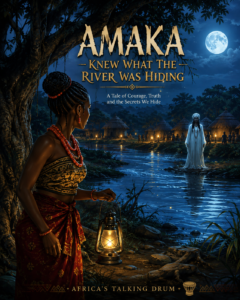
In the old village of Ogbaku, there was a river called Mmiri-Udo, whose waters supplied the village with fish, clay and drinking water.
The elders had always warned the young people never to enter the river after sunset. Nobody remembered exactly when the warning had begun, but every generation inherited it from the one before.
“Why can we not enter the river at night?” children often asked.
“Because the river belongs to the spirits after the sun goes down,” their mothers would answer.
“And what happens if somebody enters?”
“Then you should pray that the river remembers his name.”
The children usually ran away at that point.
Amaka was different. She had always questioned things that other people accepted without asking.
One afternoon, her younger brother Chukwu went towards the river to check the fishing traps their father had set near the reeds. He was expected home before the evening meal, but darkness arrived and he had not returned.
Amaka’s mother sent two men to search for him.
They returned before midnight.
“We found his sandals near the river,” one of them said.
His mother collapsed.
By morning, the whole village believed Chukwu had drowned.
Amaka refused to accept it.
“Did you see his body?” she asked.
“No.”
“Did you see him enter the river?”
“No.”
“Then how can everybody say that he is dead?”
Her uncle frowned.
“Child, must every matter become an argument?”
“I am not arguing. I am asking.”
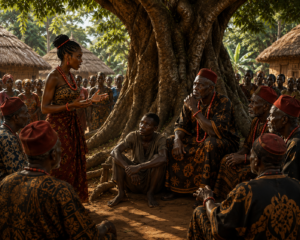
The elders held a meeting beneath the nnukwu tree. After much discussion, they agreed that Chukwu had most likely been carried away by the current.
Only Amaka remained unconvinced.
Three nights later, she went to the river alone.
She carried a small lantern and stood beneath the same iroko tree where her brother had often waited for their father to return from fishing.
She was about to turn back when she heard a voice.
“Amaka.”
She froze.
The voice came again.
“Amaka, don’t tell them I am here.”
She dropped the lantern.
“Chukwu?”
There was no answer.
She searched along the riverbank until she noticed something that made her heart pound. On the wet earth beside the water were footprints.
They began at the river and continued towards the forest.
Amaka followed them until they disappeared beneath the roots of the iroko tree.
The next morning, she ran to the elders.
“I heard Chukwu.”
Nobody spoke.
“I went to the river last night. Someone called my name.”
Old Eze Madu shook his head.
“My daughter, grief can make the heart hear what it longs to hear.”
“I saw footprints.”
“Whose?”
“I don’t know.”
“Then leave the matter alone.”
Amaka stared at him.
“Why?”
The old man lowered his eyes.
“Because some questions have brought sorrow to people who asked them before you.”
That answer frightened her more than the river itself.
She returned home but could not sleep. Her mother sat beside her that night and stroked her hair.
“Let your brother rest,” she whispered.
“What if he is not dead?”
Her mother began to cry.
“Do you think I have not asked myself the same question?”
Amaka held her mother’s hand.
“Then help me find him.”
Her mother looked towards the doorway.
“Your father once asked questions about that river.”
Amaka sat upright.
“What questions?”
“He disappeared for three days when he was young. When he returned, he refused to tell anyone where he had been.”
“Did he ever speak about it?”
“Only once.”
“What did he say?”
Her mother hesitated.
“He said, ‘The river keeps what the village is afraid to remember.’”
Amaka felt a chill run through her.
The following evening, she returned to the river.
This time she did not go alone. Her cousin Ikenna followed her secretly, carrying a torch.
When they reached the iroko tree, they heard singing from across the water.
A woman stood on the opposite bank.
She wore a white wrapper and carried a clay pot on her head.
Ikenna grabbed Amaka’s arm.
“Who is that?”
“I don’t know.”
The woman looked directly at Amaka.
“Why are you looking for the boy?”
“Because he is my brother.”
The woman nodded.
“Then you must first learn why the river took him.”
Amaka stepped closer.
“Who are you?”
“My name does not matter.”
“Where is my brother?”
The woman pointed towards the forest.
“He is alive.”
Amaka’s breath caught.
“Take me to him.”
“I cannot.”
“Why?”
“Because your village must first speak the truth.”
Before Amaka could ask another question, the woman turned away.
Ikenna shouted, “Wait!”
But she had disappeared.
They crossed the river at dawn and followed a narrow path through the forest. Before long they found an abandoned hut hidden behind thick bushes. Inside, they discovered Chukwu.
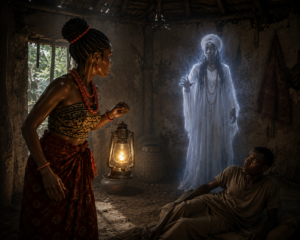
He was weak but alive.
Amaka rushed towards him.
“Chukwu!”
He looked up and began to cry.
“How did you find me?”
“We heard you.”
Chukwu shook his head.
“I did not call you.”
Amaka stopped.
“Then who did?”
He looked towards the forest.
“The woman.”
“What woman?”
“The woman who brought me here.”
Chukwu told them what had happened. He had fallen near the river and injured his leg. The mysterious woman had found him before nightfall and carried him to the hut. She had warned him not to return until someone came searching for the truth.
“What truth?” Amaka asked.
Chukwu looked frightened.
“She said our elders know why nobody is allowed near the river after sunset.”
When Amaka and Ikenna returned to the village with Chukwu, the elders were waiting.
Old Eze Madu looked at the boy for a long time before lowering his head.
“I suppose the river has finally returned what we buried in our silence.”
The villagers gathered around.
Amaka stepped forward.
“What happened?”
The old man sighed.
“Many years ago, before your grandfather was born, a group of men discovered gold-bearing stones near the river. They wanted the river for themselves, so they spread the story that a spirit lived there and would punish anyone who approached after sunset.”
“Why?”
“To keep the villagers away while they secretly collected what they found.”
“And the spirit?”
“There was none.”
The village became silent.
“But the woman?” Amaka asked.
Old Eze Madu’s face changed.
“She was the daughter of one of those men. According to the elders before us, she drowned while trying to expose what her father had done. Since that day, people have claimed to see her beside the river.”
Amaka looked towards the forest.
“So she saved Chukwu.”
The old man nodded.
“Perhaps she has been waiting all these years for someone brave enough to ask the question we were afraid to answer.”
From that day, the village changed its relationship with the river. The elders admitted that fear had been used to hide greed, and they taught the younger generation the truth behind the old warning.
The people still respected Mmiri-Udo after sunset, but they no longer feared it because of a lie.
Whenever children asked Amaka what had really happened to Chukwu, she would smile and tell them, “Your elders may know many things, but never be afraid to ask why. A question asked with courage can open a door that fear has kept locked for generations.”
And whenever the moon rose over the river, the villagers sometimes saw a woman in white standing beneath the old iroko tree.
Nobody approached her. Nobody called her name. They simply remembered that some truths may be buried for many years, but they do not disappear.
Moral: Fear can be used to hide wrongdoing, but truth eventually finds a voice. We should respect the wisdom of elders while still having the courage to ask questions when something does not make sense.
About The Author
















Leave a comment