

By : Chinasaokwu Helen Okoro
Hospitals Before Stadiums : Morocco’s Youth Protests Over Government Priorities
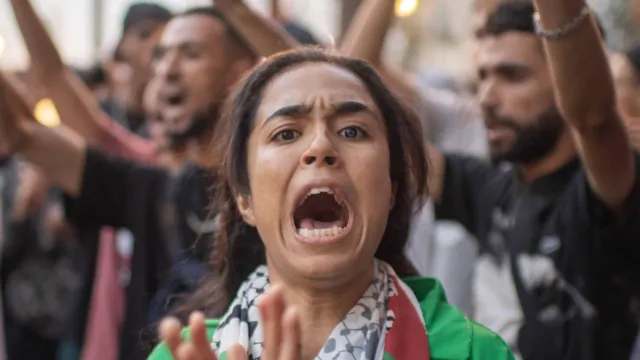
Morocco’s decision to pour billions of dollars into building the world’s largest football stadium has sparked a wave of youth-led protests across the country, with demonstrators demanding that basic needs like healthcare and education take precedence over prestige projects.
The 115,000-capacity stadium, part of preparations for co-hosting the 2030 FIFA World Cup, is estimated to cost around $5 billion (£3.7 billion) alongside other football infrastructure. But for thousands of young Moroccans, these investments symbolize a government that has misplaced its priorities.
> “I am protesting because I want my country to be better. I don’t want to leave Morocco, and I don’t want to resent my country for choosing to stay,” says 25-year-old communications manager Hajar Belhassan from Settat, about 80 km south of Casablanca.
—
Digital Generation Takes to the Streets
The movement is being spearheaded by Gen Z 212 — a youth-led group named after Morocco’s international dialing code. Organizers have used Discord, TikTok, and Instagram to coordinate demonstrations, drawing inspiration from recent Gen Z protests in Nepal.
Protests began on 27 September, spreading across 10 cities with slogans like:
“No World Cup, health comes first.”
“We want hospitals, not football stadiums.”
The crowds have grown daily, reflecting deep frustrations with public services. Authorities have responded with mass arrests and, in some cities, violent crackdowns. At least three protesters have died so far.
Rooted in Real Tragedy
Public anger intensified following the mid-September deaths of eight women in a maternity ward in Agadir. Reports suggested the women might have survived with adequate medical care, equipment, and staffing.
The tragedy highlighted Morocco’s healthcare shortfall: in 2023, the country had just 7.8 doctors per 10,000 people, far below the WHO recommendation of 23.
For many protesters, this was the breaking point. “Health and education are necessities that should already be prioritised,” Belhassan says. “It breaks my heart to see young, educated and peaceful people faced with arbitrary arrests.”
Arrests and Clashes
Police have attempted to suppress gatherings, leading to widespread detentions. Belhassan recalls being fearful of making eye contact with officers while protesting.
According to Interior Ministry spokesman Rachid El Khalfi, as of Wednesday:
409 people had been detained,
260 police officers and 20 protesters were injured,
40 police vehicles and 20 private cars were torched in clashes.
Voices from the Movement
Among those detained was Hakim, a 23-year-old protester from Casablanca. He says he joined the demonstrations peacefully but ended up in a crowded police cell.
> “This government has been abusing their power too much,” Hakim says. “My father had a stroke recently. Without our savings for private care, he would have died. What am I gaining from a country that can’t provide healthcare for my ageing parents or quality education for me?”
He criticizes the state education system as lagging far behind the private sector. “We deserve a dignified life,” he adds. “We want to host the World Cup, but with our heads held high—not hiding behind a façade.”
A Movement with Clear Demands
The Gen Z 212 movement has issued a list of demands on social media, calling for:
Free, quality education for all
Accessible public healthcare
Decent, affordable housing
Improved public transport
Subsidized basic goods and lower prices
Better wages and pensions
Youth employment opportunities
Adoption of English (instead of French) as the second national language after Arabic
Prime Minister Aziz Akhannouch has said he is open to dialogue. But the leaderless movement vows to continue until it sees “concrete change.”
—
A Generation Redefining Priorities
For Morocco’s young protesters, the issue goes far beyond football. Their nightly demonstrations represent a demand for dignity, equality, and a future built on social investment—not just global spectacle.
As the government presses ahead with its World Cup ambitions, it faces a growing movement determined to remind it that stadiums don’t heal the sick, teach children, or create jobs.
About The Author













Leave a comment