

By Chinasaokwu Helen Okoro
Life of the Bajau: The Ocean Nomads
For centuries, the Bajau people—often called the “sea nomads” or “gypsies of the sea”—have lived in harmony with the ocean, drifting across the waters of Southeast Asia. Found mainly in the maritime regions of the Philippines, Malaysia, and Indonesia, the Bajau have no fixed homeland. The sea is their life, their livelihood, and their legacy. They are among the last true nomadic seafaring peoples in the modern world, their lives intricately woven with the rhythms of the tides.
A Life Afloat
Traditionally, the Bajau lived almost entirely on houseboats known as lepa-lepa, small wooden vessels where they slept, cooked, and raised their children. Their world stretched across the turquoise expanse of the Sulu and Celebes Seas. They followed the fish and the seasons, moving wherever the waters were generous.
Today, many Bajau have settled in stilt houses built above shallow coastal waters, yet their bond with the sea remains unbroken. Their settlements are often built miles from the mainland, accessible only by boat. The children learn to swim before they can walk, and many spend more time in the water than on land.
Masters of the Deep
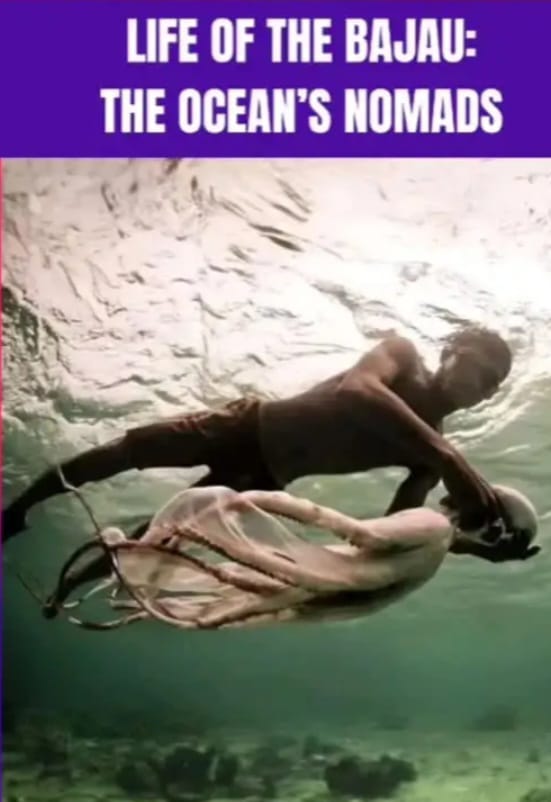
The Bajau are famed for their extraordinary diving abilities. Without modern equipment, they can dive to depths of over 60 meters (200 feet) and stay underwater for several minutes while spearfishing or collecting sea cucumbers, shellfish, and pearls. Scientists have discovered that the Bajau’s spleens are about 50 percent larger than those of land-dwelling neighbors—an adaptation that allows them to hold their breath longer by storing more oxygenated red blood cells.
Using handmade wooden goggles and weights carved from stone, Bajau divers descend gracefully into the deep, their bodies moving as fluidly as the fish they pursue. Their lungs, trained through generations of free diving, expand and contract with ease, a remarkable testament to human adaptation and endurance.
Culture and Belief
Despite their scattered communities, the Bajau share a rich culture and spiritual connection to the sea. Many believe that spirits dwell beneath the waves and that the ocean itself must be respected, not conquered. Rituals are held before long journeys or fishing expeditions, offering thanks to the sea for its bounty.
Music and dance are also integral to Bajau life. The lepa-lepa festival in Semporna, Malaysia, celebrates their maritime heritage with decorated boats, traditional songs, and dances that mimic the motion of waves. Oral storytelling keeps their history alive, passing down legends of ancient seafarers and mythical ocean creatures.
Modern Challenges
In recent decades, the Bajau way of life has faced increasing pressure. Government policies have encouraged—or forced—many to settle permanently on land, ending centuries of nomadic freedom. Overfishing, coral reef destruction, and climate change have also reduced their natural resources. Without formal citizenship in some regions, many Bajau struggle to access education, healthcare, and legal protection.
Some younger Bajau are leaving their maritime traditions behind, seeking work on land or in cities. Yet, for others, the pull of the sea remains irresistible. Even as modernity encroaches, the Bajau identity continues to flow with the tides.
Guardians of the Sea
The Bajau’s deep understanding of marine ecosystems offers valuable lessons for sustainable living. Their respect for nature and skill in navigating the ocean show a balance between human life and the environment that modern societies often forget.
Preserving Bajau culture is not just about protecting a people—it is about safeguarding a way of life that honors the ocean as both home and teacher. As the world faces rising seas and dwindling fish stocks, the wisdom of the Bajau, the ocean nomads, may hold the key to a more harmonious relationship with our blue planet.
In the end, the Bajau remind us that home is not always a place on land—it can be the endless horizon, the song of the waves, and the deep, living heart of the sea itself.
About The Author





















Leave a comment