

By: Chioma Madonna Ndukwu
Africa’s Talking Drum: The Village That Chased the Mirror
In the riverside kingdom of Enduli, the people once lived simply. Fishermen rose before dawn. Potters shaped clay beneath mango trees. Children raced barefoot through dusty paths while elders shared stories beneath the moonlight.
Life was not perfect, but the people of Enduli knew one another well. Then one season, traders arrived from distant lands carrying a strange object no one had ever seen before:
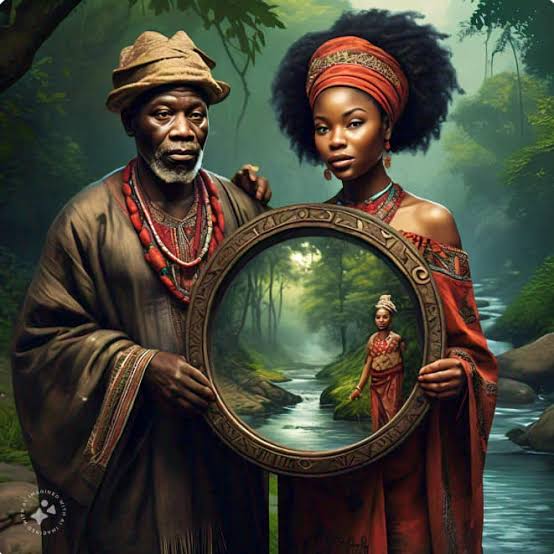
A giant mirror. It was taller than a doorway and clearer than still water. When the villagers looked into it, they gasped in amazement.
The mirror made everyone appear grander, brighter, more important. Soon, crowds gathered around it daily.
Young men admired themselves for hours. Women compared their reflections endlessly. Even village leaders began holding meetings beside the mirror so they could appear powerful before the people.
Before long, the kingdom changed. Farmers abandoned fields early just to stand before the mirror.
Traders neglected their stalls. Even friends who once laughed together now competed over who looked wealthier, stronger, or more admired in the reflection.
And the more the people stared into the mirror, the less they noticed the world around them. The rivers became dirtier. The roads cracked. The harvests weakened.
Still, no one paid attention. The mirror had become the center of Enduli. Then one windy evening, a violent storm swept through the village square and shattered the giant mirror into thousands of pieces.
The people rushed outside in horror.Some wept openly. Others searched desperately through the broken glass trying to recover fragments of their reflection.
But as the days passed without the mirror, something unexpected happened. The villagers slowly began noticing one another again.
Children returned to the fields to play and neighbors resumed evening conversations. Farmers repaired neglected farms together.
And for the first time in many seasons, the people truly looked at their kingdom instead of their reflections.
One sunset, an old canoe maker spoke quietly beside the river: “We became so obsessed with how we appeared,” he said, “that we forgot who we actually were.”
Silence settled over Enduli. For the people realized the mirror had not only reflected their faces, it had quietly fed their vanity, distraction, and division.
From that day forward, the villagers never rebuilt the giant mirror. Instead, they rebuilt their community.
And though smaller mirrors still existed in homes and markets, the people of Enduli learned never to let reflection become more important than reality.
Moral: A society obsessed with image and appearance may slowly lose sight of its true condition.
Do you think modern life encourages people to focus more on appearance than substance?
About The Author



















Leave a comment