

By: Chioma Madonna Ndukwu
Africa’s Talking Drum: Adanne’s Husband Had No Shadow
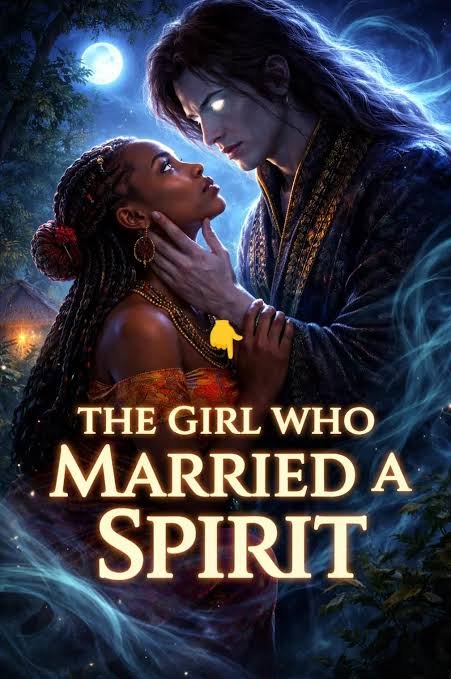
In the old days, when the moon was still believed to listen to the prayers of mothers and the forest was said to keep the secrets of anyone who entered it, there lived in the village of Umuoma a young woman named Adanne.
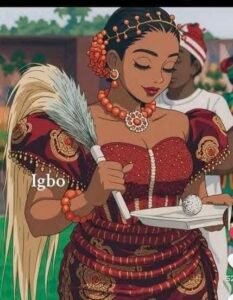
People travelled from distant villages to see her. She was beautiful enough to make young men forget the messages they had come to deliver, and proud enough to know that beauty had given her such power.
Whenever a man came to ask for her hand, she listened carefully before finding a reason to send him away.
One had many goats but no fertile farmland. Another had a large yam barn but spoke too loudly. A third was handsome, but his mother was from a distant village.
When her mother finally asked, “My daughter, what kind of man are you waiting for?” Adanne laughed.
“I will know him when I see him.”
Her mother shook her head.
“Then open your eyes well. A person’s face may introduce him, but only his character will tell you who he is.”
Adanne did not understand the warning.
One evening, while the women were returning from the stream, a stranger entered Umuoma.
He was dressed in fine white cloth, wore coral beads around his neck and carried himself like a man accustomed to being greeted before he greeted others.
He told the elders that his name was Obiora and that his father ruled a wealthy kingdom beyond the great forest.
When Adanne saw him at the village square, she could not hide her admiration.
Her friend Mgbada noticed immediately.
“Is this the man you have been waiting for?”
Adanne smiled.
“Perhaps.”
Mgbada laughed.
“At last, you have found a man without a fault.”
Adanne watched Obiora as he greeted the elders.
“Look at him,” she whispered. “Even the way he walks is different.”
Obiora soon sent his people to Adanne’s family with gifts of kolanuts, jars of palm wine, fine cloth and ornaments that no one in Umuoma had seen before. He spoke gently to Adanne’s mother and showed great respect to the elders.
When her mother asked where his father’s kingdom could be found, he pointed towards the forest.
“Beyond the seven hills,” he said. “Our people live where the red earth meets the great river.”
The elders nodded. Such distant kingdoms were not unusual in those days, and nobody considered it strange that they had never heard of his father’s people.
Still, Adanne’s mother remained uneasy.

One evening, she said to her daughter, “There is something about this man I do not understand.”
Adanne frowned.
“What is there to understand? He is kind, wealthy, handsome and respectful. Is that not what you have always wanted me to find?”
“I have never told you to marry a handsome man.”
“Then what have you told me?”
“To marry a good man.”
Adanne laughed.
“Mama, you are looking for a fault where there is none.”
Her mother sighed.
“A woman who is dazzled by a bright calabash may forget to ask what is inside it.”
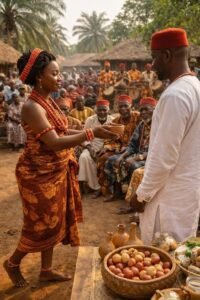
Adanne married Obiora after the elders had completed the customary rites. The celebration lasted for three days, and people came from neighbouring villages to eat, dance and bless the couple.
For a while, Adanne believed she had finally found the husband she had always imagined.
Obiora brought her beautiful beads and expensive cloth. He filled their compound with goats and yams and never allowed her to lack anything. Yet there was one thing about him that remained strange.
He never allowed her to visit his father’s kingdom. Whenever Adanne asked about it, he promised to take her after the next market day.
When the market day came, he would tell her that a messenger had arrived with news from home and that he had to remain behind.
Another time, he said the great river had risen and the forest path was dangerous.
On another occasion, he simply told her, “The time has not yet come.”
Adanne accepted each explanation because she was still looking at the husband she had dreamed about.
Her mother did not.
One afternoon, she said, “My daughter, you have been married for many moons. Have you ever seen the home from which your husband came?”
“No.”
“Have you met his father?”
“No.”
“Have you seen even one person from his kingdom?”
Adanne became irritated.
“Mama, must every question have an answer?”
Her mother looked at her.
“When a woman walks into a forest and refuses to ask where the path ends, she should not blame the forest when darkness finds her.”
Adanne said nothing.
The strange events began shortly afterwards. Obiora always returned home before sunset, yet nobody ever saw him travelling along the village paths.
Sometimes Adanne would hear his footsteps outside the compound, open the door immediately and find nobody there. At other times, he would appear beside her without making the slightest sound.
One evening, she asked him, “My husband, why do you never sit outside after sunset like the other men?”
He smiled.
“My people have always preferred the quiet of the night.”
She accepted the answer.
Then came the night of the great storm.
Rain fell heavily over Umuoma, and thunder shook the earth. Adanne and Obiora sat beside the fire while the wind pushed against the walls of their house.
Suddenly lightning flashed through the doorway.
Adanne looked at the ground.
Her husband’s shadow was missing.
She stared at him.
“Obiora.”
He turned.
“Yes, my wife?”
“Why can I not see your shadow?”
He did not answer.
Adanne moved closer to the fire, then looked again.
Nothing.
Her hands began to tremble.
“Who are you?”
Obiora’s face changed.
The handsome features she had admired for so long seemed to melt away, and the voice that came from him no longer sounded like the voice of the man she had married.
“You spent your life searching for the perfect man,” he said. “You rejected those who were poor, those who were not handsome enough, those whose clothes displeased you and those whose families did not impress you.”
Adanne backed away.
“Why are you telling me this?”
“Because you never asked what lived beneath the appearance.”
He stepped towards her.
“You wanted beauty, wealth and royalty. I gave you all three, and you never looked beyond them.”
Adanne remembered her mother’s words.
A bright calabash may hide anything inside it.
She ran from the compound before dawn and did not stop until she reached her mother’s house.
Her mother opened the door and found her trembling.
“You have seen it,” she said.
Adanne fell into her arms.
“Mama, I did not listen.”
Her mother held her quietly.
“My daughter, some lessons arrive gently. Others wait until we are ready to understand them.”
“How did you know?”
“I did not know what he was. I only knew that a man whose past cannot be found should never be trusted simply because his face is beautiful.”
Obiora disappeared before the sun reached the middle of the sky. Nobody ever saw him again.
Some elders believed he was a spirit from the forest. Others said he had come from the land of the dead and borrowed the appearance of a handsome prince to deceive Adanne. Whatever he was, his name became a warning passed from one generation to another.
Adanne never forgot the lesson.
Years later, when young women gathered around her during moonlit evenings, she would tell them, “My daughters, beauty may invite you to open a door, but wisdom must decide whom you allow to enter.”
Then the elders would add their own saying: “A person who chooses only with the eyes may discover too late what the eyes were never made to see.”
Moral: Outward beauty, wealth and status can disguise a person’s true nature. Wisdom looks beyond what is displayed and pays attention to character, truth and the things that cannot easily be seen.
About The Author














Leave a comment