

By: Chioma Madonna Ndukwu
Africa’s Talking Drum: Calabash That Never Fills
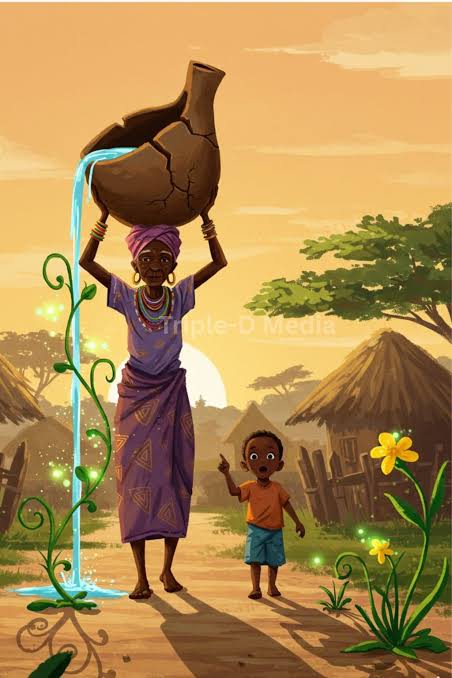
The first sound that greeted dawn in Kijani Village was the laughter of women walking to the stream with calabashes balanced gracefully on their heads.

They greeted one another as though every morning was a festival, and the village elders would often say, “A river does not choose whose thirst to quench.”
Among those women was Adaku, a widow whose small farm yielded just enough to keep her grandchildren smiling.
Whenever she returned from the stream, she filled a large calabash with water and left it beneath the shade of a mango tree for weary travellers.
One afternoon, a wealthy trader named Mosi stopped by, drank deeply, and shook his head.
“You waste too much,” he said. “Water is becoming scarce. Keep it for your own household.”
Adaku smiled.
“My mother taught me that water tastes sweeter when another mouth is refreshed.”
Mosi laughed and walked away.
Before long, fear spread across Kijani. Families began hiding their food. The village well was covered at night.
Doors that once stood open remained shut. Every household believed survival belonged to those who shared the least.
Then the dry season arrived with a fierceness no one remembered. The stream shrank into a ribbon of muddy water.
The village well gave only a few buckets each morning. People lined up before sunrise, each guarding an empty calabash as though it contained treasure.
Chief Nyaga watched the growing suspicion with a heavy heart.
“This is not the village our ancestors built,” he said.
Nobody answered.
Everyone feared there would not be enough. The next morning Adaku carried her own calabash to the stream. She returned with barely half of it filled.
As she reached the mango tree, a tired stranger staggered towards her.
“My daughter has not tasted water since yesterday,” he whispered.
The villagers watched from a distance.
One woman muttered, “If she gives him that water, her own grandchildren will thirst.”
Adaku looked at the stranger, then at her calabash.
Without hesitation, she handed it to him.
“Drink,” she said softly. “Tomorrow cannot blame us for forgetting our humanity.”
The man drank only a little before passing the calabash to his daughter.
Then he returned what remained.
“I have taken enough,” he said. “The road has taught me that a borrowed kindness must never become stolen generosity.”
An old elder, who had watched everything from beneath a neem tree, slowly rose to his feet.
“Our fathers were right,” he said. “The hand that closes to keep everything soon discovers it cannot receive anything.”
The words settled over the village like evening dew. Ashamed, one family uncovered its hidden grain. Another opened the locked well in its compound. Fishermen shared their catch.Farmers exchanged seeds instead of selling them.
No law forced them. The chief didn’t even command them, but their own consciences did. By the time the rains returned, Kijani had learned a lesson greater than survival.
The calabash under Adaku’s mango tree was never full for long because someone was always drinking from it.
Yet somehow, it was never empty when another thirsty traveller arrived. Children would often ask their grandmother how that was possible.
She would simply smile.
“A calabash emptied by kindness,” she would say, “is the easiest one for heaven to fill.”
Moral: Wealth is not measured by what we keep, but by what still reaches another person after our own needs have been met.
Comment Hook: Communities rarely become stronger through abundance alone. More often, they are rebuilt by ordinary people who refuse to let compassion become a scarce resource.
About The Author


















Leave a comment