


By: Chioma Madonna Ndukwu
Africa’s Talking Drum: Ugochi and the Stranger Who Knew Her Father’s Name
Long before the roads of Umuaro became busy with traders and travellers, a stranger arrived in the village one evening carrying nothing except a walking stick and a small leather pouch tied around his waist.
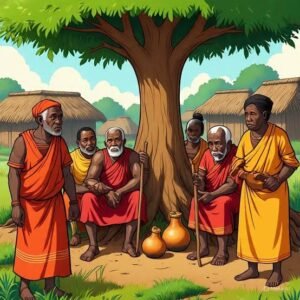
He was an old man with a grey beard, but there was something about him that made the villagers uneasy. He greeted everyone he met by name, even people he had never seen before.
When he reached the compound of Ugochi, he stopped at the entrance and asked, “Does Nwafor’s daughter still live here?”
Ugochi, who was grinding pepper beside her mother, raised her head.
“My father died many years ago. Who are you?”
The stranger looked at her carefully.
“Then you must be Ugochi.”
Her mother dropped the pestle in her hand.
“How do you know my daughter’s name?”
The stranger smiled.
“Your father told me.”
Ugochi stood up.
“My father has been dead for twelve years.”
“I know.”
Her mother moved closer to the doorway.
“Who are you?”
The stranger did not answer. Instead, he asked for water.
Ugochi brought him a calabash, and he drank slowly before returning it.
“Tell your mother that I have come to collect what your father left behind.”
Her mother stiffened.
“Nwafor left nothing with you.”
The stranger looked at her.
“He left something with you. You simply do not know that you have it.”
Before either woman could ask another question, he walked away.
That night, Ugochi could not sleep. She kept thinking about the stranger’s words. Her father had died when she was a child, and her mother had never spoken much about his final days.
“Mama,” she asked at last, “what did Papa leave behind?”
Her mother remained silent for a long time.
“Nothing that belongs to that man.”
“But how did he know Papa?”
“I do not know.”
“You must know something.”
Her mother sighed.
“Your father once travelled beyond the great river with three other men. When he returned, he brought nothing home except a scar on his chest and a promise that he would never speak about what happened there.”
“What happened?”
“He refused to tell me.”
The following morning, the stranger returned.
This time, several elders followed him to Ugochi’s compound.
Chief Ezeokeke asked, “Who are you, and why have you come to Umuaro?”
The stranger bowed.
“My name is Madu. I knew Nwafor when we were young.”
One elder frowned.
“Nwafor had no friend called Madu.”
The stranger smiled.
“That is because he knew me by another name.”
The elders exchanged glances.
Madu reached into his leather pouch and brought out a small brass pendant.
Ugochi recognised it immediately.
“That belonged to my father.”
Her mother covered her mouth.
“Where did you get it?”
Madu looked at her.
“Your husband gave it to me the night we separated.”
The elders demanded to know what had happened, but Madu refused to speak before the entire village.
“Bring the oldest people of Umuaro together tonight,” he said. “Your village has carried a secret for longer than Ugochi has been alive.”
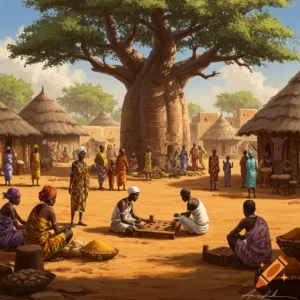
By sunset, the villagers had gathered beneath the ancient iroko tree.
Madu stood before them.
“Many years ago, Nwafor and I travelled with two other men to the far side of the great river. We went searching for a sacred grove that our fathers had warned us never to enter.”
Someone in the crowd whispered, “Why did you go?”
Madu looked down.
“Greed.”
The elders became silent.
He explained that the four young men had heard stories of a hidden chamber where an ancient king had buried gold and precious ornaments before his death. They wanted to find it.
“We found the chamber,” Madu continued, “but we also found something else.”
“What?” Chief Ezeokeke asked.
“A warning carved into the wall.”
Ugochi leaned forward.
“What did it say?”
Madu looked at her.
“It said that whoever took what did not belong to him would carry its burden until he returned it.”
The four men laughed at the warning and took the treasure. But before they could leave the grove, one of them fell ill. Another disappeared.
Madu and Nwafor escaped with the treasure, but fear followed them all the way home.
“Nwafor wanted to return it,” Madu said. “I refused.”
The village listened in silence.
“He eventually hid his share and told me that if anything happened to him, I must return it.”
Ugochi stared at him.
“Where is it?”
Madu pointed towards her mother’s compound.
“Your father buried it beneath the old mango tree.”
Her mother began to tremble.
“I never knew.”
They dug beneath the tree and found a clay pot sealed with wax. Inside were gold ornaments and ancient beads.
Madu looked at Ugochi.
“Your father kept his promise until his death. I was the one who broke mine.”
“Why did you return now?” she asked.
The old man lowered his head.
“Because I have grown old, and I have learned that a man may hide a stolen things from his neighbours, but he cannot hide it from his own conscience.”
The elders ordered that the treasure be returned to the distant community from which it had been taken. Madu offered to lead the journey.
Ugochi’s mother looked at him.
“Why did you wait twelve years?”
Madu’s eyes filled with tears.
“Because shame made me run from the truth. Age finally made me tired of running.”
The villagers returned the treasure, and the people of the distant community received it with solemn gratitude.
When Madu came back to Umuaro, Ugochi asked him one final question.
“How did you know my name when you first came?”
The old man smiled.
“Your father spoke of you often. He told me that you had his stubbornness and your mother’s courage.”
Ugochi laughed softly.
“Then he knew me well.”
“He did.”
Madu prepared to leave the village the following morning. Before he departed, Ugochi’s mother gave him food for the journey.
He accepted it with both hands.
“Your husband was a good man,” he said.
She shook her head.
“He made a terrible mistake.”
Madu smiled sadly.
“A good man can make a terrible mistake. What separates him from a wicked man is what he does after he discovers it.”
After the stranger left, Ugochi stood beneath the mango tree where the treasure had been buried.
Her mother joined her.
“Mama, do you think Papa was afraid?”
“Of course he was.”
“Then why did he try to return what he took?”
Her mother looked towards the road where Madu had disappeared.
“Because courage is sometimes nothing more than deciding to correct what fear made you do.”
From that day, the elders of Umuaro taught their children the story of Nwafor and Madu.
They reminded them that greed could lead a person into places where courage alone might not bring him back, and that admitting a wrong did not erase the wrong, but refusing to correct it allowed the wrong to become part of one’s name.
Years later, whenever a stranger entered Umuaro and greeted an old person by name, the children would whisper that perhaps another secret had returned from the past.
The elders would smile and say, “A village may bury gold, but it should never bury the truth. One day, somebody will come looking for both.”
Moral: A wrong deed does not disappear simply because it is hidden. True repentance requires the courage to face the past, accept responsibility and make amends.
About The Author
















Leave a comment