

By: Chioma Madonna Ndukwu
Africa’s Talking Drum: The Woman Who Counted Harvests
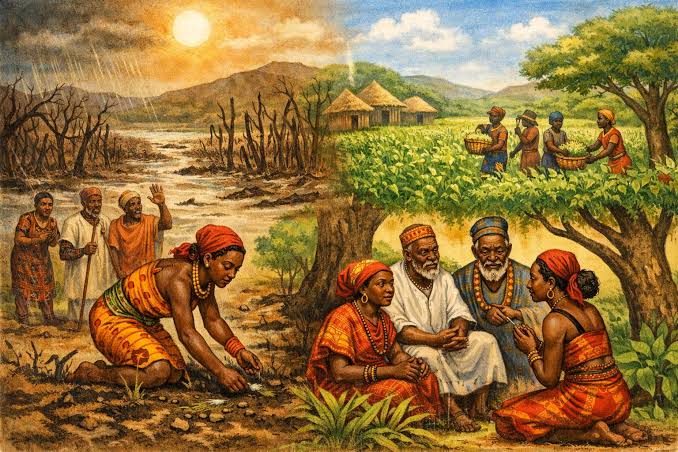
In Ndulue Village, far beyond the quiet bends of Kanyira Grove, life was measured not by clocks but by harvest seasons.
When the yam barns were full, the village laughed loudly. When they were half-empty, people spoke carefully. And when they were nearly bare, even greetings became shorter.
It was in such a season that Amina arrived.
No one knew exactly where she came from. Some said she crossed the river during early harmattan. Others said she simply appeared at the edge of the market one morning with a small notebook tied in cloth.
She did not sell food. She did not farm. She did not trade. She counted. At first, the villagers found her harmless.
Every morning, she would sit near the granary and write. She would ask farmers how many baskets they harvested, how many they sold, and how many they kept at home.
A yam farmer once laughed at her. “Why are you counting what you will not eat?”
Amina only smiled. “Because what is not counted is easily lost.”
He waved her off. But she kept counting.
Over time, something strange began to happen in Ndulue Village. Harvests that used to fill barns began to reduce, but nobody could explain where the difference went.
Traders blamed transport. Farmers blamed weather. Elders blamed young people. Young people blamed elders. But Amina did not blame anyone. She only wrote.
One evening, under the iroko tree near the village square, she spoke for the first time without being asked.
“Your harvest is not disappearing,” she said. “It is moving.”
A man frowned. “Moving where?”
She closed her notebook slightly. “That is what the counting is showing.”
The square went quiet.
The village head cleared his throat. “We do not need fear. We need stability.”
Amina nodded slightly. “Stability comes from knowing where things go.”
No one responded. Because no one liked the idea that something in the village was going somewhere without permission.
Days passed, then weeks, the yam barns continued to shrink. And Amina’s notebook continued to fill. One morning, a young farmer approached her quietly.
“My father’s barn was full,” he said. “Now it is not even half. But we did not sell that much.”
Amina looked at him for a long moment. “Did anyone come to ‘help’ store your harvest?”
He paused. Then slowly nodded. That was when things started connecting.
At the village meetings, a group of respected middlemen had been offering to “protect” farmers’ harvests. They promised safety from theft, better storage, and future returns.
So people agreed, because it sounded responsible. Because everyone was tired. Because trust is easier when you are exhausted. But returns never matched deposits. And complaints always met the same answer:
“Your account is still balancing.”
That night, Ndulue Village gathered again under the iroko tree, but this time Amina brought her notebook with her. She did not raise her voice. She simply opened it.
“Here,” she said, turning pages slowly. “This is what was harvested. This is what was handed over. This is what returned.”
A man in the crowd frowned. “Are you accusing people?”
Amina shook her head. “I am counting what you stopped counting.”
Silence followed, heavier than before. Because numbers are patient. And truth written down does not argue.
The village head tried to speak, but a farmer interrupted first.
“So my barn is empty because I trusted storage?”
Another voice followed. “And my harvest?”
Then another. “And mine?”
The iroko tree did not move, but the air beneath it changed. Amina finally closed her notebook.
“I did not create this problem,” she said quietly. “I only recorded it long enough for you to see it.”
That was the moment Ndulue Village changed, not with shouting, but with noticing. Farmers began checking their own barns again. Conversations replaced assumptions. Questions replaced silence.
And the “middlemen” who once stood at the centre of everything suddenly found fewer people willing to hand over what they had worked for.
Nothing collapsed violently. It simply stopped being unquestioned. And Amina? She did not stay long after that season.
Some said she left before the next harvest. Others said she simply stopped appearing at the granary, but her notebook remained in the minds of those who saw it.
Because in Ndulue Village, people learned something they had forgotten: what is not tracked can be quietly taken.
Moral: What is not observed, measured, or questioned is the easiest thing to lose.
Comment Hook: When a community begins to lose what it cannot explain, silence is usually already part of the problem.
About The Author



















Leave a comment