

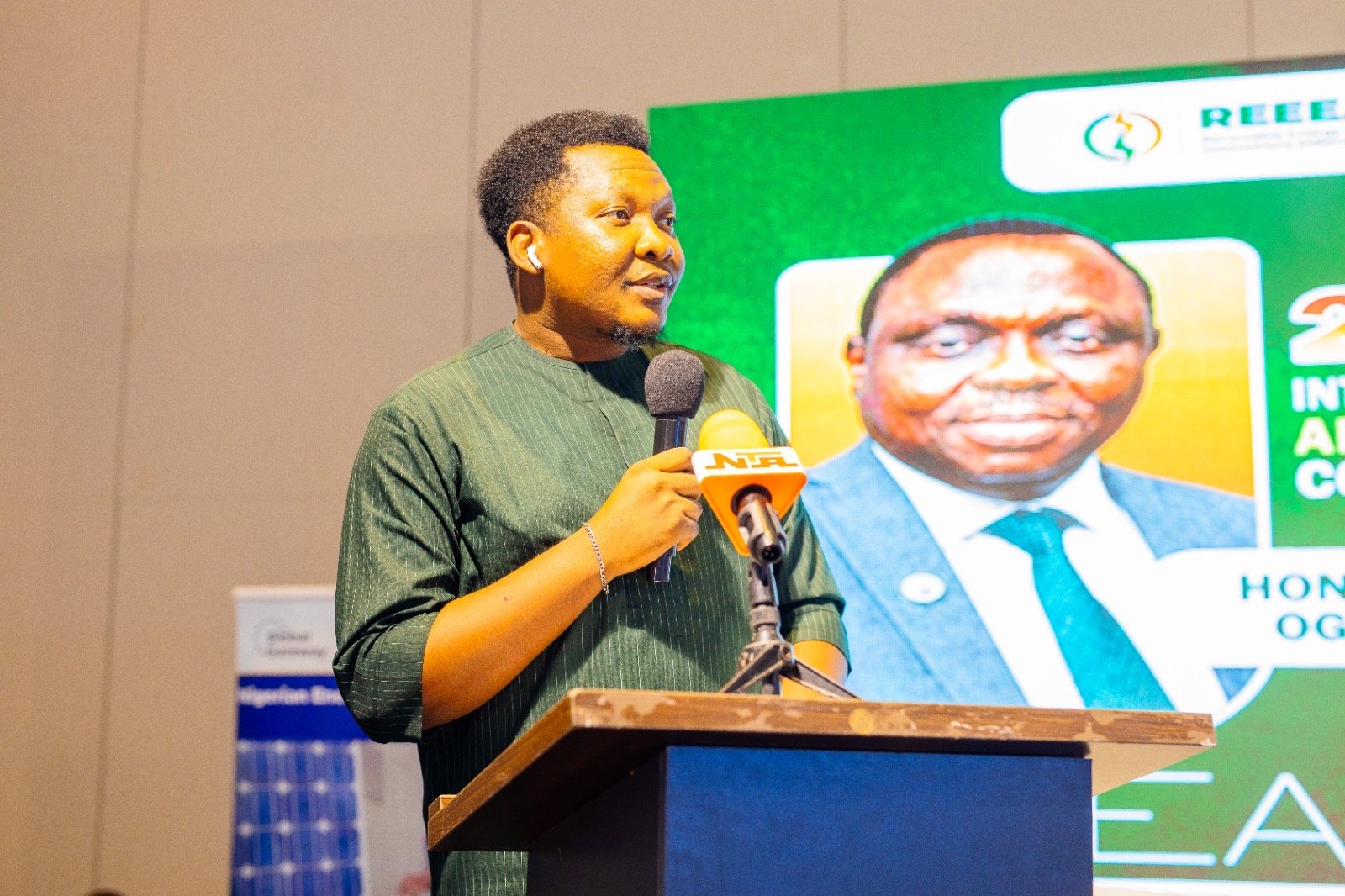
REEEA-Alliance adopts 12-point action plan to boost clean energy investment
The Renewable Energy and Energy Efficiency Associations Alliance (REEEA-Alliance) has adopted a 12-point Action Communiqué to address barriers to investment and deployment in Nigeria’s clean-energy sector.

The communiqué was adopted at the end of the alliance’s 5th International Investment and Partnership Conference held at the Marriott Hotel, Ikeja, Lagos.
The two-day conference had the theme: “Accelerating Collective Action and Strategic Partnerships for Equitable Clean Energy Access.”
It brought together policymakers, state government representatives, development-finance institutions, international development partners, commercial financiers, energy developers and professional associations.
The stakeholders pledged to move Nigeria’s clean-energy sector from policy formulation to bankable projects, accessible finance and measurable implementation.
The conference identified policy certainty, financing, technical standards, market structures and human-capital development as critical to expanding clean-energy access.
Participants noted that grid electricity supply remained between 3,500MW and 4,500MW for a population of more than 220 million.
They said the electricity supply deficit had forced businesses, particularly in commercial centres such as Lagos, to depend heavily on costly diesel and petrol-powered generators.
The stakeholders consequently identified decentralised clean-energy markets as both an energy-access necessity and an economic opportunity.
Dr Imamuddeen Talba, Pioneer Chairman of the REEEA-Alliance Steering Committee, urged stakeholders to move from policy formulation to practical and bankable project execution.
The Director-General of the Energy Commission of Nigeria, Dr Mustapha Abdullahi, represented by Dr Aminu Isa, also provided insights into the commission’s efforts toward policy implementation.
Engr. Ayodeji Dada, who was inaugurated as President of the Governing Council of REEEA-Alliance on the first day, presided over the second-day proceedings.
Dada highlighted opportunities created by the Electricity Act 2023, particularly the development of sub-national electricity markets.
He said stronger state-level markets, supported by predictable federal fiscal incentives, would create the certainty needed to attract investment into decentralised clean-energy projects.
The communiqué called for stronger coordination among the Federal Ministry of Finance, Presidential Enabling Business Environment Council (PEBEC) and Nigeria Customs Service.
It said such coordination would facilitate access to Import Duty Exemption Certificates and VAT exemptions for qualifying clean-energy investments.
The stakeholders also recognised financing instruments supporting decentralised energy deployment, including the 750-million-dollar World Bank-supported Distributed Access through Renewable Energy Scale-Up (DARES) programme.
They noted that the programme included a 188-million-dollar Green Finance and Investment Facility and was designed to support the electrification of 226,000 households through 40 interconnected mini-grids.
The conference called for project debt to be denominated in single-digit local-currency interest rates to reduce foreign-exchange risks and improve project viability.
Mr Olasunkanmi Owoeye, Group Head at Sterling Bank, said the bank’s HEART strategy had unlocked more than N50 billion in climate loans.
Owoeye said the bank was targeting N200 billion in climate financing by the end of 2026.
The conference also featured an Investment Lounge designed to directly connect clean-energy developers with financiers, development-finance institutions, investment facilitators and potential strategic partners.
The platform provided opportunities for developers to explore financing options while enabling investors and funding connectors to assess viable clean-energy projects.
Among participants were representatives of the Africa Regional Representation of the Green Climate Fund, Barr. Titi Akosa, Mr Henry Bassey of GreenHub Africa and Mr Boluwasope Ogboye, Founder and Principal Consultant of The BOPFA Company.
The stakeholders also endorsed the promotion of PROSPECT, a digital telemetry platform aimed at improving transparency and reducing information gaps between clean-energy projects and financiers.
Supported by the European Union, BMZ and GET.invest, the platform tracks more than 180 million euros in clean-energy assets across 21 countries.
The conference called for the integration of PROSPECT telemetry into Nigeria’s clean-energy investment ecosystem to improve project monitoring, due diligence and financing decisions.
On equipment standards, the communiqué called for mandatory pre-shipment Standards Organisation of Nigeria Conformity Assessment Programme (SONCAP) verification.
It also called for an Extended Producer Responsibility framework for lithium-ion batteries and battery-related electronic waste.
The stakeholders said stronger quality control was necessary to prevent substandard equipment from undermining consumer confidence and legitimate investment.
On human capital, the conference established a 30 per cent inclusion target for women in technical and leadership positions in the clean-energy sector.
It also proposed paid engineering placements for up to 1,000 young women annually through mentorship, internship and leadership-development programmes.
The conference further declared energy efficiency as the “first fuel” and called for stronger enforcement of Minimum Energy Performance Standards.
It proposed an Energy Efficiency Trust Fund capable of subsidising up to 50 per cent of capital expenditure for industrial energy-efficiency retrofits.
The participants said energy-efficiency investments could reduce operating costs, lower energy demand and improve the competitiveness of Nigerian businesses.
The conference also reviewed the institutional development of REEEA-Alliance, noting its expansion from five to seven constituent associations and the activation of 11 Standing Working Committees.
It also recognised institutions and individuals through its annual awards, including the Rural Electrification Agency, Sterling Bank, GIZ and Ondo State Governor, Lucky Aiyedatiwa.
The alliance said the resolutions were intended to create stronger links among policy, finance, technology, human capital and market development.
It stressed that the success of the communiqué would ultimately depend on implementation, measurable outcomes and clear institutional responsibilities.
The alliance said Nigeria needed projects capable of attracting capital, financing structures suited to local developers, reliable project data and standards capable of protecting consumers and investors.
It also emphasised the need to expand opportunities for women and young professionals while strengthening cooperation among government, financiers, businesses and development partners.
The REEEA-Alliance said its conference had therefore sought to move discussions beyond policy declarations towards execution, investment mobilisation and practical delivery.
The alliance said the 12-point communiqué provided a framework for creating a clean-energy market that was more bankable, transparent, inclusive and execution-focused.
It added that the next step would be to translate the resolutions into timelines, institutional responsibilities, investment pipelines and measurable outcomes.

The Renewable Energy and Energy Efficiency Associations Alliance is an umbrella coalition of constituent trade associations, private developers and institutional partners involved in Nigeria’s sustainable-energy transition.
About The Author



















Leave a comment