

By: Chioma Madonna Ndukwu
Rivers Power Play Puts Tinubu in a Political Tight Corner
As Nigeria inches closer to the 2027 general elections, President Bola Ahmed Tinubu is facing one of his most delicate political tests yet — how to manage the deepening power struggle in Rivers State without losing its prized bloc votes.
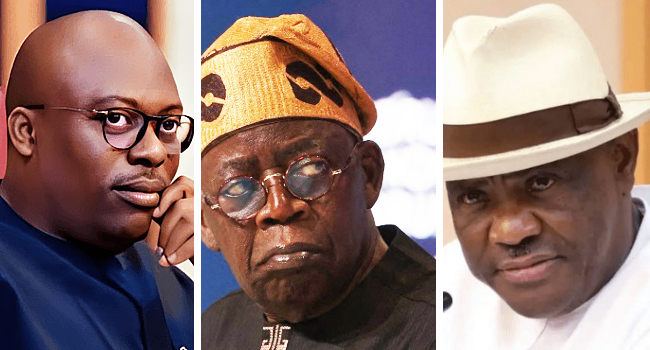
At the centre of the storm are two powerful figures pulling in opposite directions: Minister of the Federal Capital Territory, Nyesom Wike, and Rivers State Governor, Siminalayi Fubara.
Both men command influence, loyalty, and political structures, but only one can realistically deliver Rivers to Tinubu’s camp in 2027.
Wike, a long-time power broker in Rivers politics, remains a member of the Peoples Democratic Party (PDP) while serving as one of the most prominent figures in Tinubu’s APC-led federal government.
Fubara, on the other hand, recently crossed from the PDP to the APC in what many observers see as a survival move amid shifting political alliances.
When Fubara assumed office in May 2023, his emergence was widely interpreted as a continuation of Wike’s political legacy.
Wike’s influence was believed to have played a decisive role in his rise. But that alliance collapsed almost as quickly as it formed, giving way to open hostility, accusations of betrayal, and a fierce struggle for control of Rivers’ political machinery.
The rift spiralled into a full-blown crisis in 2025 when President Tinubu declared emergency rule in Rivers State, suspending democratic structures amid escalating tensions between the governor and the House of Assembly, which is largely loyal to Wike.
The move was widely interpreted as an attempt to halt an imminent impeachment of Fubara.
During the six months that followed, Rivers was governed by a sole administrator, retired Vice Admiral Ibok-Ete Ibas.
Within that period, Wike’s political allies strengthened their grip, restructured local power blocs, conducted local government elections, and installed loyalists across the councils — a development that significantly weakened Fubara’s base.
Ironically, the emergency rule also breathed new life into Fubara’s political fortunes. The impeachment was halted, and by September 2025, he was reinstated as governor.
On his return, Fubara struck a careful tone, pledging loyalty to both President Tinubu and Wike — a move seen as strategic rather than reconciliatory.
The fragile balance did not last long.
Fubara’s decision to defect from the PDP to the APC altered the political equation and was viewed by analysts as a direct challenge to Wike’s dominance.
While the governor’s camp insists the defection positions him as the APC leader in Rivers, Wike’s allies strongly disagree.
Wike has repeatedly argued that party leadership is not determined by registration dates or political titles but by grassroots control. According to him, Fubara’s defection alone does not automatically translate to leadership of the APC in the state.
The rivalry escalated again earlier this year when the Rivers State House of Assembly initiated impeachment proceedings against Fubara and his deputy, Ngozi Nma Odu. Although the presidency remained officially silent, reports suggested presidential intervention halted the process.
That position appeared to gain clarity when Tinubu’s Special Adviser on Policy and Communication, Daniel Bwala, publicly affirmed the President’s support for Fubara, insisting the governor must be allowed to carry out his duties without undue interference.
While acknowledging Wike’s importance to the administration, Bwala stressed that the FCT minister is not a member of the APC.
With these developments, the question confronting the presidency is no longer subtle: who truly holds the key to Rivers in 2027?
Political voices are divided. Dr Adetokunbo Pearse, a PDP chieftain, argues that political logic favours the sitting governor, who controls state resources and commands institutional authority.
He insists that Rivers remains fundamentally a PDP state and that neither Wike’s influence nor federal backing can easily shift voter loyalty.
Others, like political analyst Dr Sani Abubakar, are more blunt. He believes the President has little choice but to work with Fubara, noting that political precedent across Nigeria shows federal leaders aligning with governors who control party structures and resources on the ground.
Abubakar also downplays Wike’s perceived electoral value, describing him as increasingly polarising and politically expensive. According to him, the President’s decision to publicly protect Fubara already signals where power is tilting.
Still, Wike maintains that his strength lies in ward-level networks and local mobilisation, particularly in the South-South. Supporters argue that his political machinery remains formidable, even if controversial.
As the 2027 elections draw closer, analysts suggest Tinubu may attempt a delicate balancing act — leveraging Wike’s organisational reach while consolidating Fubara’s authority as governor.
Whether that balance can hold, or whether Rivers will force a definitive choice, remains one of the most consequential political questions ahead of the next election cycle.
About The Author












Leave a comment