

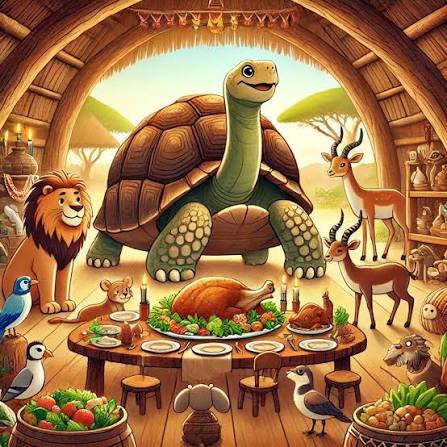
By: Chioma Madonna Ndukwu
Africa’s Talking Drum: The Tortoise Who Bought Time
In Kanyira Grove, a wide stretch of forest where animals traded, argued, and rebuilt their lives under shifting seasons, the market was usually the one place where everything made sense.
But there came a season when even the market began to behave strangely, as if it had forgotten its own balance.
The rains had been kind that year, the harvest was full, and food was everywhere. Yet somehow, nothing seemed to stay the same for long.
The tortoise noticed it first. Every time he went to the market, prices had already changed before the day even settled.
A bundle of plantains yesterday was not the same story today. A basket of grain that fed a goat family last week now left them counting hunger instead of satisfaction.
He stood at a stall one morning and looked at the seller.
“Why does food grow more expensive faster than it grows in the soil?” he asked.
The seller chuckled. “You ask like someone who still trusts the ground.”
But the tortoise did not laugh.
Because he had begun to notice something else in Kanyira Grove. Money was moving faster than food. And the animals were no longer asking questions about it.
At the centre of the market, a group of baboons had stepped into a new kind of role. They did not force anyone, at least not at first. They only advised.
“Why carry your earnings around?” they said smoothly. “Leave it with us. We will keep it safer than your pockets.”
It sounded reasonable, even helpful. So animals agreed.
Goats deposited their earnings. Antelopes trusted them. Even the birds, who usually carried doubt like a second wing, tried once and then watched carefully.
But when they came back for what they left behind, the answers were always the same.
“Come tomorrow.”
“The system is not ready yet.”
“Your name is still being processed.”
The tortoise listened without reacting much, but he stopped leaving quickly. He stayed longer each day, watching how the words repeated like a cycle that never broke.
One morning, a goat cried out near the stall.
“I brought enough for my family,” she said, shaking. “Now you are telling me it is not here?”
A baboon replied calmly, “It is not gone. It is just… processing.”
That word spread through Kanyira Grove like a soft cover over confusion. Processing. It explained everything without explaining anything.
That evening, the tortoise finally climbed onto a wooden crate near the market edge and spoke loud enough for those around him to hear.
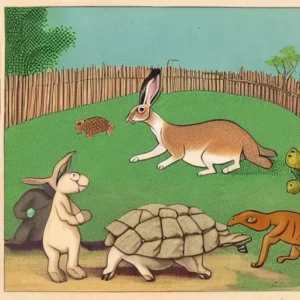
“If everything is processing,” he said slowly, “why is only hunger finishing its work?”
The sound of the market shifted slightly, not loud, just aware. Some animals stopped moving for a moment. Even the baboons smiled less than before.
That night, Kanyira Grove did not sleep loudly. Animals gathered in corners instead of centres.
A rabbit said quietly, “I sold my goods and still returned hungry.”
A goat replied, “I saved my earnings and cannot find them anymore.”
The birds flew lower than usual, not singing as much, just watching.
And the tortoise?
He simply said, “A market is not broken when food disappears. It is broken when trust stops asking questions.”
By morning, something had already begun to shift. Not through confrontation, but through withdrawal. Animals started trading directly again.
Fewer of them left their earnings in the baboon stalls. Conversations replaced deposits. Questions replaced silence. The baboons still smiled. But fewer animals stood in their line.
And slowly, the centre of control in Kanyira Grove became less crowded, not by force, but by understanding. Because once trust begins to leave a system, it does not announce itself. It simply stops returning.
In Kanyira Grove, the tortoise did not fight the system, he made people see it.
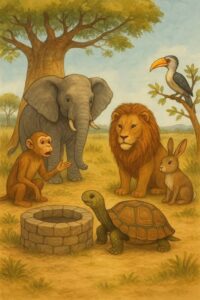
Moral: A system does not collapse suddenly; it weakens when people stop questioning what no longer makes sense.
Comment Hook: When trust begins to fail in everyday life, what holds a community together—rules, or awareness?
About The Author
















Leave a comment