
Home News Africa Africa’s Talking Drum: The Tortoise Who Bought Time
Africa

Africa’s Talking Drum: The Tortoise Who Bought Time

Share
Share

By: Chioma Madonna Ndukwu

Africa’s Talking Drum: The Tortoise Who Bought Time

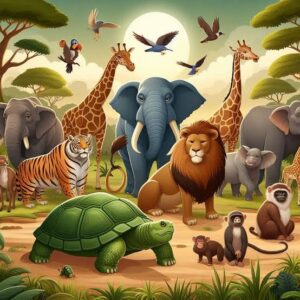
In Kanyira Grove, a wide stretch of forest where animals traded, argued, and rebuilt their lives under shifting seasons, the market was usually the one place where everything made sense.


But there came a season when even the market began to behave strangely, as if it had forgotten its own balance.

The rains had been kind that year, the harvest was full, and food was everywhere. Yet somehow, nothing seemed to stay the same for long.

The tortoise noticed it first. Every time he went to the market, prices had already changed before the day even settled.

A bundle of plantains yesterday was not the same story today. A basket of grain that fed a goat family last week now left them counting hunger instead of satisfaction.
He stood at a stall one morning and looked at the seller.

“Why does food grow more expensive faster than it grows in the soil?” he asked.

The seller chuckled. “You ask like someone who still trusts the ground.”

But the tortoise did not laugh.

Because he had begun to notice something else in Kanyira Grove. Money was moving faster than food. And the animals were no longer asking questions about it.

At the centre of the market, a group of baboons had stepped into a new kind of role. They did not force anyone, at least not at first. They only advised.
“Why carry your earnings around?” they said smoothly. “Leave it with us. We will keep it safer than your pockets.”

It sounded reasonable, even helpful. So animals agreed.

Goats deposited their earnings. Antelopes trusted them. Even the birds, who usually carried doubt like a second wing, tried once and then watched carefully.

But when they came back for what they left behind, the answers were always the same.

“Come tomorrow.”

“The system is not ready yet.”

“Your name is still being processed.”

The tortoise listened without reacting much, but he stopped leaving quickly. He stayed longer each day, watching how the words repeated like a cycle that never broke.

One morning, a goat cried out near the stall.

“I brought enough for my family,” she said, shaking. “Now you are telling me it is not here?”

A baboon replied calmly, “It is not gone. It is just… processing.”

That word spread through Kanyira Grove like a soft cover over confusion. Processing. It explained everything without explaining anything.

That evening, the tortoise finally climbed onto a wooden crate near the market edge and spoke loud enough for those around him to hear.
“If everything is processing,” he said slowly, “why is only hunger finishing its work?”

The sound of the market shifted slightly, not loud, just aware. Some animals stopped moving for a moment. Even the baboons smiled less than before.

That night, Kanyira Grove did not sleep loudly. Animals gathered in corners instead of centres.

A rabbit said quietly, “I sold my goods and still returned hungry.”

A goat replied, “I saved my earnings and cannot find them anymore.”

The birds flew lower than usual, not singing as much, just watching.

And the tortoise?

He simply said, “A market is not broken when food disappears. It is broken when trust stops asking questions.”

By morning, something had already begun to shift. Not through confrontation, but through withdrawal. Animals started trading directly again.

Fewer of them left their earnings in the baboon stalls. Conversations replaced deposits.  Questions replaced silence. The baboons still smiled. But fewer animals stood in their line.

And slowly, the centre of control in Kanyira Grove became less crowded, not by force, but by understanding. Because once trust begins to leave a system, it does not announce itself. It simply stops returning.

In Kanyira Grove, the tortoise did not fight the system, he made people see it.
Moral: A system does not collapse suddenly; it weakens when people stop questioning what no longer makes sense.

Comment Hook: When trust begins to fail in everyday life, what holds a community together—rules, or awareness?

About The Author

Share

Leave a comment

Leave a Reply

Your email address will not be published. Required fields are marked *

LATEST POST

News

Radiant diGiLog offers digital solution to logistics operational gaps

Radiant diGiLog offers digital solution to logistics operational gaps An indigenous technology firm, Radiant diGiLog, says its workforce management platform is helping logistics...

International

Oil Market Takes New Turn as US, Iran Pause Military Attacks

Oil Market Takes New Turn as US, Iran Pause Military Attacks Global oil prices fell sharply on Monday after the United States and...

International

Second Shooting Incident Reported Outside Toronto US Consulate in Four Months

Second Shooting Incident Reported Outside Toronto US Consulate in Four Months A second shooting incident has been reported outside the United States Consulate...

AfricaConflict

VIDEO: 8 Children Among 30 Killed in Kaduna Community Attack

VIDEO: 8 Children Among 30 Killed in Kaduna Community Attack At least 30 people, including eight children, have been killed after armed attackers...

HealthOpinion

Health Risks of Making Late-Night Eating a Habit

By: Chioma Madonna Ndukwu Health Risks of Making Late-Night Eating a Habit There is a particular kind of hunger that comes after midnight....

Sport

WAFCON 2026: Senegal Fall to Algeria as Morocco Make Winning Start

WAFCON 2026: Senegal Fall to Algeria as Morocco Make Winning Start Senegal began their 2026 Women’s Africa Cup of Nations campaign with a...

ConflictInternational

US Suspends Iran Bombing as Trump Considers Next Move

US Suspends Iran Bombing as Trump Considers Next Move The United States has suspended its strikes on Iran for a third consecutive night...

AfricaEntertainment

BBNaija Season 11: Meet the Housemates Battling for ₦160m Grand Prize

BBNaija Season 11: Meet the Housemates Battling for ₦160m Grand Prize The 11th season of Big Brother Naija has officially kicked off with...

Metro

Sewuese Dies After Allegedly Being Trafficked to Cotonou for Prostitution

Sewuese Dies After Allegedly Being Trafficked to Cotonou for Prostitution A young Nigerian woman identified as Sewuese has died after she was allegedly...

Entertainment

Shakira Reveals What Drew Her to Burna Boy for World Cup Song

Shakira Reveals What Drew Her to Burna Boy for World Cup Song Colombian superstar Shakira has explained why she turned to Nigerian Grammy-winning...

Security

Wanted Soldier Arrested While Allegedly Supplying Military Uniforms to Terrorists

Wanted Soldier Arrested While Allegedly Supplying Military Uniforms to Terrorists Troops of the Nigerian Army have arrested a soldier who had been declared...

Related Articles

VIDEO: 8 Children Among 30 Killed in Kaduna Community Attack

VIDEO: 8 Children Among 30 Killed in Kaduna Community Attack At least...

BBNaija Season 11: Meet the Housemates Battling for ₦160m Grand Prize

BBNaija Season 11: Meet the Housemates Battling for ₦160m Grand Prize The...

Africa’s Talking Drum: Mama Nkem Left Before Her Daughter Was Ready

By: Chioma Madonna Ndukwu Africa’s Talking Drum: Mama Nkem Left Before Her...

Harvard-Trained Nigerian-American Engineer Raises $7m for Robot Designed to Assist Hair Braiders A Nigerian-American engineer and Harvard graduate, Yinka Ogunbiyi, has secured $7 million in seed funding to develop a robotic device designed to make hair braiding faster and less physically demanding for professional stylists. Ogunbiyi’s company, HaloBraid, is developing what it describes as the world’s first patented braid-assist robot. The device is designed to work with hairstylists by handling some of the repetitive movements involved in knotless braiding. The funding round was led by Seven Seven Six, a venture capital firm founded by Reddit co-founder Alexis Ohanian. AlleyCorp and Bling Capital were also among the investors. The technology has already attracted significant interest, with more than 7,000 salons reportedly waiting to use the system. HaloBraid is designed as a collaborative robot, meaning it works alongside a human stylist instead of attempting to replace one. The hairstylist remains responsible for sectioning the hair, creating the initial knot and completing the final styling. The robot then assists with the repetitive weaving process down the length of the braid before the stylist returns to finish and shape the ends. According to the company, the technology could cut the time spent on some knotless braid appointments by roughly half, allowing salons to serve more clients while reducing the physical pressure on stylists. For Ogunbiyi, the idea was born from personal experience. During the COVID-19 pandemic, she spent four days installing knotless braids on herself, an experience that made her consider how technology could assist with the most repetitive aspects of the process. She subsequently teamed up with co-founder David Afolabi to develop HaloBraid. The company’s technology is also aimed at addressing the physical demands of professional braiding. Stylists who spend years performing repetitive movements can experience problems affecting their wrists, hands, shoulders, back and joints. By assisting with the most repetitive stage of braiding, HaloBraid hopes to reduce the strain on beauty professionals and help them work more efficiently. Ogunbiyi said the technology would not take away from the personal experience of visiting a salon. Rather, she believes it can allow stylists to spend less time on repetitive movements while continuing to handle the creative and personal aspects of hairstyling. Before launching HaloBraid, Ogunbiyi worked on smart kitchen appliances and Internet of Things products. She holds a joint master’s degree in engineering and business administration from Harvard University. With a $7 million investment and thousands of salons already expressing interest, HaloBraid is seeking to introduce robotics into one of the world’s largest and most labour-intensive beauty markets.

Harvard-Trained Nigerian-American Engineer Raises $7m for Robot Designed to Assist Hair Braiders...