

By: Chioma Madonna Ndukwu
Africa’s Talking Drum: Nwando Heard Her Name Inside the Empty Calabash
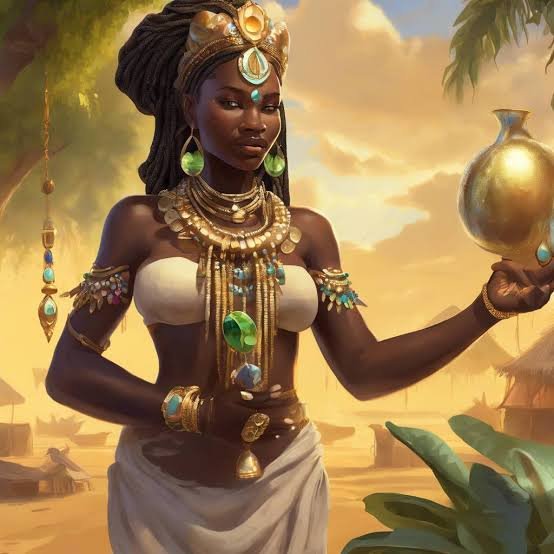
In the old village of Umueze, there lived a young woman named Nwando whose voice was so beautiful that people often stopped what they were doing whenever she sang.

She could sing while pounding yam, while sweeping the compound and even while walking home from the stream, and people said that birds sometimes followed her because they loved the sound.
Nwando lived with her mother, who sold dried fish at the village market. They were poor, but they had never gone to bed without food.
One market day, an old woman whom nobody knew entered the village carrying three clay pots and a large calabash. She sat beneath the udala tree and began calling people towards her.
“Come and see what I have brought from beyond the seven hills,” she announced.
Children gathered first, followed by women and curious young men. Inside the first pot was honey that remained sweet even after being exposed to the sun. The second contained beads of unusual beauty, while the third held small pieces of gold.
Then she lifted the calabash.
“This one,” she said, “contains something more valuable than gold.”
One of the villagers laughed.
“What can be more valuable than gold?”
The old woman smiled.
“Your deepest desire.”
The laughter stopped.
She explained that whoever placed a hand inside the calabash and spoke the desire hidden in the heart would receive it before the next moon appeared.
Chief Okwara frowned.
“Such things should not be sold in a village without the elders’ permission.”
The old woman bowed.
“I ask for no payment. I only offer what people secretly wish to possess.”
Several villagers stepped forward, but the old woman turned each one away.
“You are asking for what your mouth wants,” she told them. “The calabash only answers what your heart truly desires.”
When Nwando heard this, she became curious.
That evening, she asked her mother, “Mama, what would you ask the calabash for?”
Her mother laughed.
“Enough food to last us through the dry season.”
“And nothing else?”
“What else does a poor widow need?”
Nwando smiled.
“I would ask for wealth.”
Her mother became serious.
“Be careful with things that promise to give you what you desire without asking what they will take from you.”
The following morning, Nwando returned to the udala tree.
The old woman was waiting.
“You have come.”
Nwando nodded.
“I want to try.”
The old woman studied her face.
“Are you certain?”
“Yes.”
“Then put your hand inside.”
Nwando reached into the empty-looking calabash.
At first, she felt nothing.
Then she heard a whisper.
“Nwando.”
She pulled her hand back.
“Who called me?”
The old woman smiled.
“You heard nothing.”
“I heard my name.”
“You heard what was already inside your heart.”
Nwando looked into the calabash, but it was empty.
The old woman asked, “What do you desire?”
Nwando hesitated.
“I want wealth.”
The old woman nodded.
“You shall have it.”
That same evening, Nwando’s mother discovered a small wooden box beneath their sleeping mat. Inside were gold ornaments, coral beads and enough money to make the poorest family in the village wealthy.
Her mother stared at the treasure.
“Where did this come from?”
Nwando told her everything.
The old woman became frightened.
“Take it back.”
“How?”
“Return it to whoever gave it to you.”
Nwando laughed.
“Mama, you prayed for food and now we have enough wealth to feed the whole village.”
Her mother touched one of the coral beads.
“This is too much.”
Nwando ignored her.
Within a few weeks, their mud house became the finest compound in Umueze. Nwando bought fine cloth and ornaments and began eating from decorated wooden bowls while her mother continued to warn her.
One afternoon, a widow came to their compound asking for food.
Nwando’s mother filled a small basket with yam and dried fish.
Nwando stopped her.
“Why are you giving away our food?”
Her mother looked at her.
“Because we once needed someone to give us theirs.”
Nwando shook her head.
“We are no longer poor.”
The widow left with nothing.
That night, Nwando heard a whisper from inside her room.
“Nwando.”
She sat up.
“Who is there?”
There was no answer.
The following night, she heard it again.
“Nwando.”
She searched the room but found nobody.
On the third night, she heard the voice coming from the calabash the old woman had left behind.
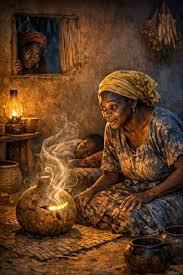
She ran to her mother.
“Mama, it is calling me.”
Her mother stared at the calabash.
“Take it outside.”
Nwando carried it beyond the compound and placed it beneath a tree.
The voice came again.
“Nwando.”
She stepped backwards.
At dawn, the calabash was back inside their house.
Her mother began to tremble.
“We must find that woman.”
They searched the market, the stream and the neighbouring villages, but nobody knew where the stranger had gone.
Then one evening, Nwando saw her standing beside the village shrine.
“Please,” she begged, “take back what you gave me.”
The old woman looked at her.
“Why?”
“Because the calabash keeps calling my name.”
“It has called your name from the beginning.”
“I do not understand.”
The old woman walked towards her.
“When you asked for wealth, the calabash did not give you gold. It revealed what wealth would make of you.”
Nwando frowned.
“What do you mean?”
“You were given enough to become generous, yet you became proud. You were given enough to feed the hungry, yet you began counting your food. The calabash did not change your heart. It simply gave your heart room to reveal itself.”
Nwando began to cry.
“Then take everything away.”
The old woman shook her head.
“That is not how such lessons work.”
“What must I do?”
“Return what you received to the people you forgot.”
The following morning, Nwando opened the wooden chest and began giving away the gold. She returned food to families she had turned away, paid the debts of widows and restored land that some villagers had sold to her after she became wealthy.
People watched in surprise.
Her mother stood beside her.
“Why are you doing this?”
Nwando wiped her tears.
“I thought wealth would make me greater than everyone else. I did not realise that it had only made my heart smaller.”
As the last gift was given away, the calabash cracked from one side to the other.
A strange wind passed through the compound. Then everything became silent. The old woman was nowhere to be found.
Nwando’s wealth disappeared with the calabash, leaving only the small house she had once shared with her mother.
Some villagers laughed when they heard what had happened. Others felt sorry for her, but Nwando accepted it all quietly.
Years later, she became known throughout the surrounding villages for feeding travellers and helping families during difficult seasons.
Whenever a young person asked why she had chosen such a life after once becoming rich, she would tell them about the mysterious calabash.
One evening, her daughter asked, “Mama, was the old woman a spirit?”
Nwando smiled.
“I do not know.”
“Then what was inside the calabash?”
Nwando looked towards the moonlit udala tree.
“Perhaps it contained nothing at all.”
Her daughter frowned.
“Then why did you hear your name?”
Nwando touched her cheek gently.
“Because sometimes the strangest voice we hear is the voice of our own heart.”
From that time, the elders of Umueze kept a saying that was remembered long after Nwando had become an old woman herself: when fortune enters a person’s house, it should also open the door of the heart.
Otherwise, wealth may fill the compound while emptiness takes possession of the person who lives inside it.
Moral: Wealth does not determine a person’s worth. What matters is how prosperity changes the way we treat others. A generous heart remains rich even when possessions disappear, while greed can turn abundance into another form of poverty.
About The Author

















Leave a comment