

By: Chioma Madonna Ndukwu
Africa’s Talking Drum: Mama Sewa Fed the Night
In Kanyira Village, people knew the night by its sounds. The frogs began first, calling from the marshes, then the crickets joined them, and somewhere beyond the baobab trees, a night bird cried into the darkness.

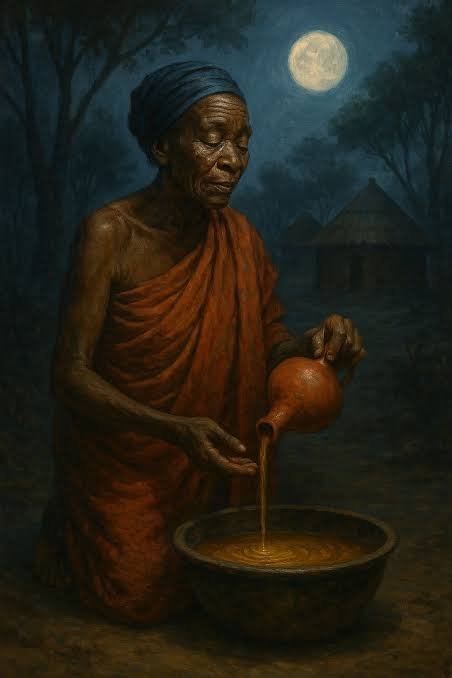
By the time the moon climbed above the rooftops, most doors were shut and most cooking fires had gone low. Except for the door of Mama Sewa.
Every night, just after the last fire died, the old widow carried a small clay bowl beyond the edge of the village.
She walked towards the forest, placed the bowl beneath a broad tamarind tree and returned without looking back. Nobody knew what she left there, but people began to notice strange things.
One morning, a farmer found pawprints around the tree. Another evening, a child claimed to have seen two shining eyes watching from the bushes. Then a goat disappeared.
Fear entered Kanyira quietly, like smoke beneath a closed door.
“It is Mama Sewa,” someone whispered at the market.
“Who else goes into the forest every night?”
“She feeds something there.”
“What kind of person feeds the night?”
By the next market day, the village had already decided that the old widow was a witch. Nobody asked her what she was doing.
That was how fear worked; it often reached a conclusion before truth had finished speaking.
Mama Sewa continued carrying her clay bowl into the forest. One night, a young boy named Kito followed her. He moved carefully between the shadows, stepping where the dry leaves would not betray him.
Mama Sewa reached the tamarind tree and placed the bowl on the ground before sitting down. For a long time, nothing happened. Then the bushes moved.
A thin, frightened child crawled out. Another child followed, and then a third. They were weak and covered in dust. Mama Sewa opened a small bundle she had carried beneath her wrapper.
“Eat slowly,” she said. “There is enough for tonight.”
The children gathered around the bowl. Kito stared at them. The village had been looking for a witch. Instead, he had found three hungry children.
The next morning, he ran to the village square and told everyone what he had seen. When people laughed and insisted that he must have misunderstood,
Kito stood his ground. “I saw them,” he said. “Mama Sewa is not feeding the night. She is feeding children.”
Chief Manda, who had been listening, raised his hand. “Then take us there.”
They found the three children beneath the tamarind tree. The oldest was a boy of about ten, his younger sister clung to his arm, and the smallest child slept against Mama Sewa’s lap. The village fell silent.
Chief Manda looked at the old woman. “Who are they?”
Mama Sewa lowered her eyes. “They are my sister’s children. She died during the last fever, and their father never returned from the northern road.”
A woman stepped forward. “Why did you hide them?”
Mama Sewa looked at the villagers. “Because I asked for help, and no one came.” She paused before adding, “I took them into my home, but there was not enough food. So I began bringing them here at night. I did not want people to see them and call them a burden.”
Nobody spoke.
The woman who had first called Mama Sewa a witch began to cry. “We saw you carrying food into the forest, and we decided what you were doing.”
Mama Sewa nodded slowly. “My mother used to say, ‘When fear enters the house, even the shadow of a friend begins to look like an enemy.’”
Chief Manda lowered his head. “We allowed suspicion to speak before truth.”
Just then, a hunter arrived from the forest with news about the missing goat. He had found its remains near the stream, along with the unmistakable tracks of a leopard.
The goat had not been taken by Mama Sewa, and the children had not been eating stolen food. The woman the village had feared had been feeding children whom the entire community had forgotten.
That evening, Mama Sewa did not carry a bowl into the forest. She no longer needed to. The women of Kanyira arrived at her compound with baskets of cassava and dried fish. Farmers brought grain, the hunter brought meat, and even the children carried small gifts.
Chief Manda stood before the old widow. “From today, those children belong to Kanyira.”
Mama Sewa smiled gently. “They belonged to Kanyira before today. You simply remembered.”
From that night onward, nobody whispered about witchcraft at Mama Sewa’s door. The three children slept beneath her roof, and the old widow no longer fed the night alone.

The people of Kanyira had finally learned that fear does not need magic to destroy a community. Sometimes, all it needs is an unanswered question.
Moral: Suspicion can turn kindness into witchcraft and make a community punish the very person carrying its forgotten burdens.
Comment Hook: Before fear gives someone a name, let truth have the chance to introduce them.
About The Author



















Leave a comment