

By: Chioma Madonna Ndukwu
Africa’s Talking Drum: The Day Umuoji Raised Its Voice
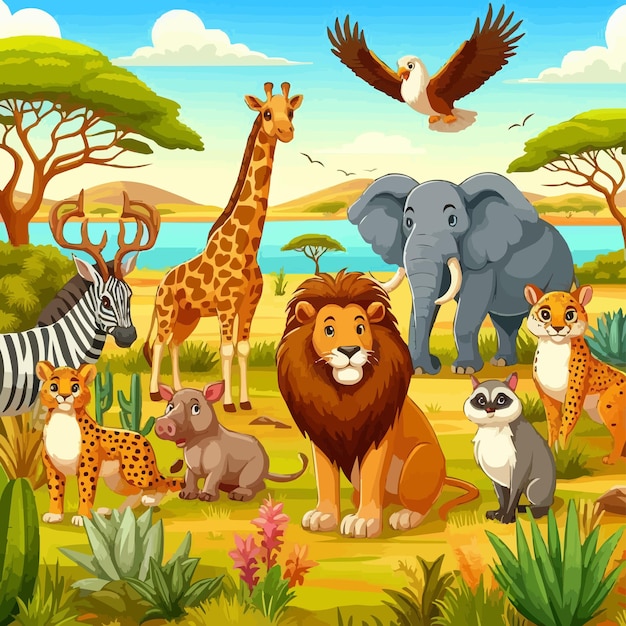
In Umuoji, the palm tree at the centre of the village square had stood long enough to see births, burials, harvests, and seasons that came and went without asking permission. But it had never seen anything like the way animals began to arrive that morning.
They came without summons.
No drums, no praise songs, no official call from the elders.
Just movement.
Goats came first, restless and scattered. Then antelopes with eyes that hadn’t slept properly for days.
Birds circled above the square and refused to land at first, as if even the air felt uncertain. Rabbits came in small groups, stopping often to look back as though afraid something might follow them.
And then they all stopped under the palm tree. Nobody spoke at first.
That silence was already different from the usual silence of fear. This one felt like something holding itself together too tightly.
The lion, who usually spoke for the council, arrived late. He walked slowly, expecting the usual waiting crowd.
But when he reached the centre, he noticed something strange, nobody stepped back to make space for him. He cleared his throat.
“We are aware of the situation,” he began.
A goat laughed once, not loudly, but enough for others to hear it. “You are always aware.”
The lion looked at her. “Do you have something to say?”
“I have something missing,” she replied. “My brother. Gone on a road we were told was safe.”
That word “safe” made a few animals shift their feet.
The lion tried again. “These matters are being handled.”
That was when the baboon stepped forward.
“Handled?” he repeated. “Like the hare that never returned? Like the goat kids taken near the river? Like the antelope we buried in questions instead of bodies?”
A murmur moved through the crowd, not loud yet, but awake.
The lion’s voice sharpened. “You are turning a serious matter into noise.”
And that was the moment something inside the square changed direction.
A tortoise moved slowly into the open space. Nobody stopped him. Nobody usually does. He looked around before speaking.
“We have been quiet for too long,” he said. “Every disappearance came with a promise. Every promise came with silence after.”
No one interrupted him. Even the birds had stopped flapping.
Then the mother goat who had been standing alone stepped forward again. Her voice shook, but she didn’t step back.
“My two children went out,” she said. “Only one came back. I went to report. They told me to wait. I waited. I am still waiting.”
Her voice broke slightly, but she did not stop speaking.
“While I wait, more disappear.”
That was when others started speaking at once, not because they planned to, but because they could no longer hold it.
“It is not only one family.”
“It is not only one path.”
“It is not only one season.”
“It is every week.”
The square that used to be controlled by order was now moving on something else entirely.
The lion raised his voice. “This is not how we resolve issues!”
A goat answered without looking at him. “Then how do we resolve disappearing lives?”
That question did not get a response. Because there wasn’t one that had worked.
Someone from the back shouted, “We keep gathering, and nothing changes!”
Another voice followed, “We keep hearing speeches, and still bury our own!”
And then the birds finally dropped from the sky, landing in clusters around the square, cutting through the last space of authority with presence instead of words.
The lion looked around now, slower.
“You are challenging the order of the village,” he said.
And a rabbit replied, “No. We are telling you the order has failed us.”
That line did not create chaos, it created agreement. Not all at once, but slowly, like something spreading through a body that had been numb for too long.
Then the goats did something unexpected. One by one, they turned away from the centre of the square, not running, not attacking, just refusing to face it anymore.
Others followed. The birds shifted direction. The antelopes moved with them. Even the rabbits turned.
And suddenly the centre of Umuoji, the place where speeches used to control everything, became empty while the edges became alive.
The lion stood still, no longer followed by the space he used to occupy. No one touched him, no one chased him, but no one listened the same way anymore.
That night, when the hyenas tried to enter Umuoji again, they met something unfamiliar, not silence, not fear.
But animals moving together without confusion, without waiting for instructions, without splitting into panic. The hyenas hesitated, that hesitation was enough.
They retreated into the forest without taking anyone. Morning came differently after that, not peaceful, but changed.
The palm tree still stood at the centre of the square, but it no longer felt like it owned the voices around it.
Because now, Umuoji had learned something it could not unlearn. Waiting had a limit, and silence had finally crossed it.
Moral:
When fear is ignored for too long, it stops asking for permission and becomes collective action.
Engagement Hook:
When protection fails repeatedly, does a community still owe silence, or does it owe itself survival?
About The Author
















Leave a comment