

By: Chioma Madonna Ndukwu
Nigeria’s Battle Over Nnamdi Kanu’s Freedom Turns the Courtroom into the New Protest Ground
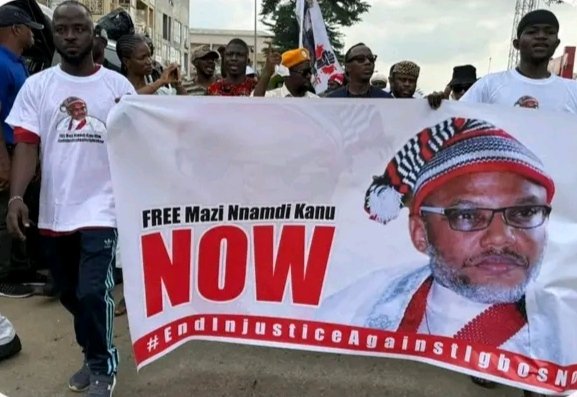
In Abuja’s heavy October air, where power breathes through barricades and fear moves in sirens, justice once again found itself gasping for breath. Tear gas clouded the streets like a fog of denial, and yet the chants rose: “Free Nnamdi Kanu!”, cutting through the smoke like a stubborn heartbeat.
For the men and women who poured into the capital to demand freedom for the detained leader of the Indigenous People of Biafra (IPOB), it was not just a protest. It was a prayer wrapped in courage and defiance.
“Freedom,” Nelson Mandela once said, “cannot be achieved unless the people have been liberated from all forms of oppression.” But in Nigeria, those who speak of freedom often find themselves staring into the barrel of authority.
On Monday, security forces turned Abuja into a fortress. Major roads were blocked, commuters stranded, and protesters tear-gassed. It was a demonstration called by activist Omoyele Sowore, but long before it began, a Federal High Court order had already tried to stop it.
Justice M.G. Umar, in Suit No. FHC/ABJ/CS/2202/2025, had issued a restraining order barring Sowore and others from staging any protests for Kanu’s release near key government zones, from Aso Rock to Eagle Square. The ink had barely dried before boots hit the pavement and tear gas canisters kissed the sky.
Ironically, while one court silenced the streets, another had already spoken and its voice was clear. Months earlier, the Court of Appeal had acquitted Nnamdi Kanu of all terrorism charges, ruling that his extraordinary rendition from Kenya violated international and domestic laws. The judgment ordered his immediate and unconditional release.
Yet, the ruling was ignored. The police, in defiance of judicial authority, refused to grant him bail, citing “national security concerns.” And so, while the gavel declared freedom, the hand that held the key refused to turn.
As one Abuja lawyer quipped, “In Nigeria, justice sometimes travels with a limp and those who wait for her often grow old before she arrives.”
Africaworldnews reporter, OMA, carried out Interview in Umuahia, Abia State
Standing beside a newsstand in Umuahia, Chinonso Uche, a secondary school teacher, looked weary yet defiant. “How can one court free a man and another court forbid people from demanding that same freedom?” he asked, his voice sharp as chalk on slate.
He shook his head. “They say Nigeria is a democracy, but democracy without justice is a song without melody. The judiciary spoke, the executive chose to go deaf. What do you call that if not selective hearing?”
To Chinonso, the issue has outgrown Kanu. “It’s not about IPOB anymore. It’s about a government that fears its own laws. When law enforcement refuses to enforce the law, we are living in irony.”
He smiled bitterly. “We teach our students about the rule of law, but what do we tell them when the law itself becomes the prisoner?”
Another interview was carried out in Abuja
In her modest Maitama office, Barrister Grace Danladi’s shelves groaned under the weight of legal briefs and broken faith. “The restraining order against the protest,” she said, “is a dangerous precedent. The Constitution guarantees freedom of expression and assembly. A temporary injunction cannot silence a fundamental right.”
She flipped through a folder containing the 2022 Court of Appeal judgment that acquitted Kanu. “This ruling was explicit,” she said, tapping the page. “It did not say ‘grant him conditional bail.’ It said ‘release him unconditionally.’ But instead of compliance, we got contempt disguised as patriotism.”
Grace paused, her tone cooling into irony. “When two arms of government the judiciary and the executive; are at war, it is the citizen that bleeds.” Quoting the late Gani Fawehinmi, she added softly: “The law is not a toy for the powerful; it is the staff of the oppressed.”
Oma, Africaworldnews reporter interviewed a Lagos State resident, Abimbola Ogunleye
Inside her small café in Surulere, Ezinne Opara, an entrepreneur and political commentator, stirred her coffee thoughtfully. “One court says don’t protest. Another says he should be free. And the police? They obey neither. That’s not governance,that’s confusion in uniform,” she said, half-laughing, half-fuming.
She leaned back. “The more they suppress dissent, the louder the whispers become. Abuja thought it was shutting down a march; instead, it ignited a movement.”
Ezinne’s words were laced with both sarcasm and sorrow. “If court orders can be obeyed selectively, then justice has become a market commodity, sold to the highest bidder or buried under bureaucratic red tape.”
As she adjusted her headwrap, she concluded, “Kanu’s case is not just about secession, it’s about submission. Who truly runs this country? The courts, or the corridors of power?”
The Monday protest, though marred by chaos, forced a reckoning. Amnesty International condemned the police action, describing it as “a clear violation of human rights.” Lawyers, journalists, and activists were among those arrested.
The government defended the crackdown, citing the restraining order and security concerns. But critics argue that when a lawful acquittal is ignored, it ceases to be about order, it becomes about fear.
Senior Advocate of Nigeria, Oba Maduabuchi, called the protest “ill-timed,” while former Arewa Forum scribe, Anthony Sani, termed it “counterproductive.” Yet human rights lawyer Maduabuchi Idam insisted it was “a massive success,” pointing out that for the first time, Nigerians from across ethnic lines united in defiance of selective justice.
Between these voices lies the nation’s unease; a democracy uncertain of its own heartbeat, torn between obedience and outrage.
As Nnamdi Kanu enters his defence, naming a constellation of political figures; from Wike and Umahi to Buratai and Sanwo-Olu, the case has evolved from a courtroom drama into a national litmus test.
Nigeria, it seems, is standing at a junction where law meets power, and neither is willing to yield. The judiciary has spoken; the police have refused to listen. The people march; the state responds with tear gas.
Chinua Achebe once warned that “a man who brings home ant-infested wood should not complain when lizards pay him a visit.” Nigeria has long carried the wood of impunity, and now the lizards of unrest crawl freely.
From the misty streets of Umuahia to the noisy cafés of Lagos, one truth echoes like a verdict yet to be enforced: a nation that silences lawful protest while ignoring lawful judgment is not protecting peace; it is postponing crisis.
And as long as that contradiction endures, the gavel will keep trembling, unsure whether it still belongs to justice or to power.
About The Author

















Leave a comment