

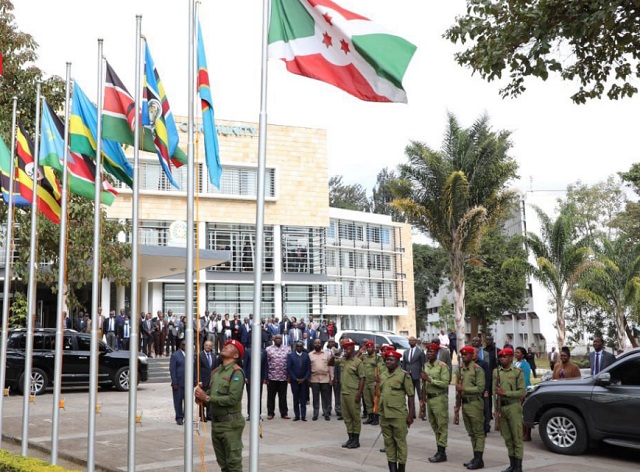
The national flag of DR Congo is hoisted in Arusha, Tanzania, following the deposit of the instrument of ratification at the EAC headquarters. COURTESY PHOTO
On July 11, the Democratic Republic of Congo officially became the seventh member of the East African Community after depositing the ‘instrument of ratification’ with the East African Community Secretary General at the bloc’s headquarters in Arusha, Tanzania.
DR Congo will now join the community and the cooperation by all the partner states in all the sectors, programmes and activities that promote the four pillars of regional integration. These pillars include the Customs Union, the Common Market, Monetary Union, and Political Federation.
Congo’s Vice Prime Minister and Minister of Foreign Affairs, Christophe Lutundula Apala Pen’ Apala, delivered the instrument of ratification to Peter Mathuki, the East African Community Secretary General.
Mathuki hailed the Congolese government and the Congolese people for speedily concluding the internal and constitutional processes to ratify the Treaty of Accession and depositing the Instrument of Ratification well ahead of schedule.
“The Summit had envisaged that this would be done by September 22, 2022,” said Mathuki.
“I am very happy to declare that today, July 11, 2022; the Democratic Republic of Congo has become the 7th Partner State of the East African Community.”
Mathuki said the Secretariat has developed a proposed roadmap for the integration of DR Congo into the community, adding that this would be shared and concluded with the participation and input of DR Congo.
Apala said his country’s entry into the East African Community was “an economic, cultural, geographical and historical obligation.” He added that Congo’s admission into the bloc was a fulfillment of the vision of the founding fathers of the African Union’s forerunner—the Organisation of African Unity (OAU)— who were in favour of a strong, united and prosperous Africa where people could trade and move freely.
He said the East African region faces similar challenges in terms of infrastructure development, insecurity, poverty, underdevelopment, disease and ignorance that can best be addressed collectively by the Partner States for the well-being of their people.
Apala described the East African Community as the most integrated bloc on the entire African continent, adding that the Summit of Heads of State also had the political will to achieve the objectives as outlined in the Treaty.
He said the entry of his country into the East African Community had strengthened the bloc’s economic, political, socio-cultural, financial and military muscle.
Tshisekedi’s dream
DR Congo’s coming within the fold of the East African Community means that the bloc now has a regional market that stretches from the Indian Ocean to the Atlantic Ocean. It has raised the region’s combined GDP by 22% and geographical area by 79%.
With its geographical area straddling about 2.4 million sq km, DR Congo is the largest sub-Saharan African country and has a population of about 87 million. Congo’s joining of the East African Community now means that the bloc’s population is now about 270 million and its GDP is about US$183 billion.
President Felix Tshisekedi’s dream to have the DR Congo integrated into the East African Community bloc started as soon as he became president at the beginning of 2019. Almost a year later, in February 2020, during the sitting of the 21st Ordinary Meeting, the Summit of Heads of State of the East African Community considered the application.
The presidents directed the East African Community Council of Ministers to expeditiously undertake a verification mission in accordance with the East African Community procedure for admission of new members into the East African Community and report to the 22nd Summit.
In June last year, the verification team began work and reviewed, among other issues, the “current status of the DR Congo in international law and the country’s level of conformity with the criteria for admission of foreign countries as provided in the Treaty.”
Under the East African Community Treaty, the criteria for the admission of new countries into the community include; acceptance of the Community as set out in the Treaty, adherence to universally acceptable principles of good governance, democracy, the rule of law, and the observance of human rights and social justice.
Other criteria include; the potential contribution to the strengthening of integration within the East African region, geographical proximity to and inter-dependence between it (foreign country) and the East African Community partners states, the establishment and maintenance of a market-driven economy, and social and economic policies being compatible with those of the Community.
When DR Congo ticked all the boxes of the East African Community’s membership criteria, a report was compiled and presented to the East African Community Council of Ministers who tabled it before the Summit of the East African Community heads of state.
On March 29, DR Congo was admitted into the Community by the Summit of East African Community Heads of State during their 19th Extra-Ordinary Meeting which was held virtually.
In April this year, the Democratic Republic of the Congo formally joined the East African Community after the signing of the Treaty of the Accession of the DR Congo into the East African Community in Nairobi, Kenya.
President Uhuru Kenyatta, the Chairperson of the Summit of East African Community Heads of State signed the Treaty of Accession with the President of DR Congo, Félix-Antoine Tshisekedi Tshilombo, at State House, Nairobi, with President Yoweri Museveni and his Rwandan counterpart, Paul Kagame, attending the event.
President Kenyatta noted that the signing of the Treaty of Accession marked the formal entry of DR Congo into the East African Community after satisfying all the conditions under Articles 3 and 4 of the Treaty for the establishment of the East African Community
Independent
About The Author














Leave a comment