

By: Chioma Madonna Ndukwu
Africa’s Talking Drum: Mama Nkem Left Before Her Daughter Was Ready
In Umuoma Village, people said that a mother’s love could cross a river without getting its wrapper wet. Nobody understood the meaning of those words better than Nkem, who had raised her only daughter, Adaeze, with two hands that never seemed to rest.

When Adaeze was born, Nkem’s husband had already joined his ancestors. She had no large farm, no wealthy relatives and no brother waiting to rescue her from hardship.
What she had was a small plot of land, a smoky cooking fire and a determination that refused to sleep.
She sold roasted groundnuts by the roadside, carried firewood from the forest and cultivated cassava during the rainy season.
Whenever Adaeze complained that her mother worked too hard, Nkem would smile and say, “A hen does not complain that her wings are tired when her chicks are still following her.”
Adaeze grew up watching her mother sacrifice one comfort after another. Nkem wore the same two wrappers for years so that her daughter could have school uniforms.
She sold her gold earrings when Adaeze needed examination fees. When the girl gained admission to a college in the city, Nkem sold the largest portion of her farmland.
“Mother, leave some land for yourself,” Adaeze pleaded.
Nkem laughed. “What will I do with land if my child has no road to walk on?”
Adaeze promised that she would one day repay everything.
Nkem shook her head. “A child does not repay a mother by returning the exact number of grains she once received. You simply grow well enough to give shade to someone else.”
Adaeze carried those words with her to the city.
She studied, found work and began sending money home. For the first time in her life, Nkem rested more than she worked. She still complained whenever Adaeze sent money.
“Keep some for yourself,” she would say.
“Mother, you spent everything on me.”
Nkem would laugh. “And did I ask you to return my old bones?”
Then, one rainy season, Nkem fell ill.
At first, she dismissed it as ordinary weakness. She continued cooking, sweeping and attending to the small garden behind the house.
But one morning, while reaching for a bucket, her knees gave way beneath her. When Adaeze heard, she returned to Umuoma immediately.
She took her mother to the hospital in the nearest town. She paid for tests, medicines and every treatment the doctors recommended.
When one doctor suggested that Nkem be taken to a larger hospital, Adaeze sold her car.
“Why are you doing all this?” Nkem asked from her hospital bed.
Adaeze looked at her.
“You did it for me.”
Nkem reached for her hand.
“My child, I did what mothers do.”
“And I will do what daughters do.”
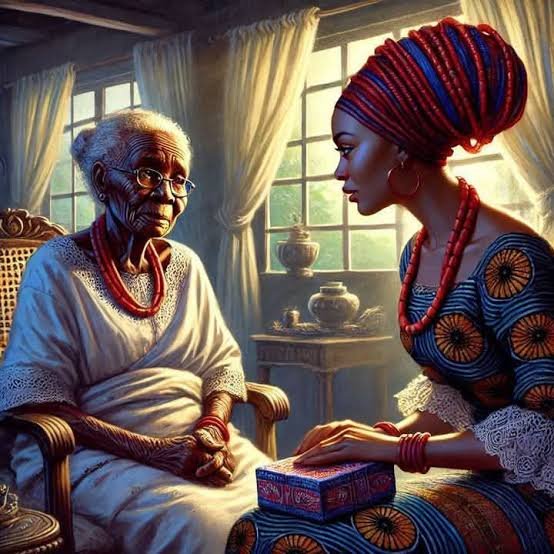
For several weeks, Adaeze refused to leave her mother’s side. She slept on a chair beside the hospital bed and fed Nkem with her own hands.
Whenever Nkem’s condition worsened, Adaeze searched for another doctor, another treatment and another possibility.
One night, Nkem opened her eyes.
“Adaeze.”
“Yes, Mama.”
“Come closer.”
Adaeze bent towards her.
Nkem studied her face for a long moment.
“You have become a woman.”
Adaeze tried to smile. “You are only noticing now?”
Nkem smiled faintly.
“I have been watching you become one since the day you first carried your own bowl.”
Adaeze held her hand tightly.
“You will come home with me.”
Nkem did not answer.
“Mama, you will come home,” Adaeze repeated.
Nkem looked towards the window, where the rain was falling against the glass.
“My child, sometimes the road ends even when the traveller is not ready to stop.”
Adaeze shook her head.
“No. We are not talking like this.”
Nkem smiled.
“A child may hold her mother’s hand with all her strength, but she cannot hold back the morning.”
Adaeze began to cry.
“I have not done enough.”
Nkem turned towards her.
“You have done enough.”
“No, Mama. I have money now. I can take you anywhere. I can find another hospital.”
“My child.”
“I can still save you.”
Nkem’s eyes softened.
“Listen to me. You were never asked to save my life. I only wanted to give you one.”
Those were the last words Nkem spoke to her daughter. She died before sunrise.
For many months after the burial, Adaeze moved through life as if she had misplaced something important.
She returned to the city, but every success tasted strangely empty. She kept remembering the hospital bed, the medicines, the doctors and all the things she had tried.
Whenever the memory of her mother’s final night returned, one question followed it.
Why was everything I did not enough?
One evening, unable to bear the question any longer, Adaeze returned to Umuoma. She walked to the small farm her mother had once sold part of to pay her school fees.
The land had been left untouched since Nkem’s illness. Adaeze stood there until darkness began to gather.
Then she noticed something. Near the old boundary, a young tree had grown. She did not remember seeing it before.
She called an elderly neighbour who had known her mother.
“That tree came from your mother’s farm,” the woman told her.
Adaeze touched its small leaves.
“My mother planted it?”
The old woman smiled.
“Your mother planted many things.”
Adaeze looked around the land.
The cassava, the old mango tree, the narrow footpath, the well her mother had repaired, all of them carried traces of the woman who had spent her life preparing a future she would never live to see.
Then Adaeze finally understood. She had spent months asking why she had failed to save her mother.
But her mother had never measured her life by the day she died. She had measured it by the life she had given her daughter.
Adaeze sat beneath the young tree and wept until the tears became quieter.
The following morning, she returned to the city and began a small foundation for young girls whose mothers could not afford their education. She named it after Nkem.
Whenever anyone asked why she had done it, Adaeze would answer, “My mother spent her life planting trees whose shade she knew she might never sit beneath.”
Years later, when Adaeze had grown old, a young girl once asked her whether she still missed her mother.
Adaeze smiled.
“Every day.”
“Then why are you smiling?”
Adaeze looked towards the tree planted in Nkem’s name.
“Because grief is what love becomes when the person we love is no longer here to receive it. I learned to let mine grow.”
And that is why the people of Umuoma still tell the story of Mama Nkem and her daughter. Not because death is easy to accept, not because love can always prevent loss.
But because sometimes, a mother spends her entire life building a road she will never walk, and the greatest way her child can honour her is to keep walking.
Moral: A child may be unable to save a parent’s life and still have done everything love could ask of them. Some sacrifices are not meant to be repaid; they are meant to be continued.
Comment Hook: We do not always honour those we have lost by refusing to live without them. Sometimes, we honour them by allowing the love they gave us to become shelter for someone else.
About The Author

















Leave a comment