

By: Chioma Madonna Ndukwu
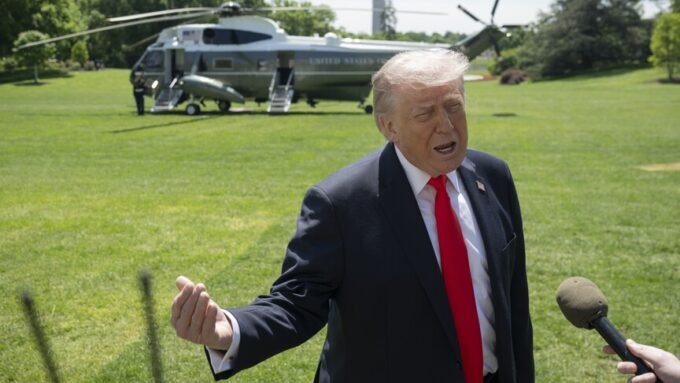
When President Donald Trump praised Liberian President Joseph Boakai’s English, he likely thought he was offering a simple compliment. After all, English is Liberia’s official language, and it is the very tongue through which the country communicates with the rest of the world. But what may have seemed like a casual remark to one person quickly turned into a storm of criticism and reflection on Africa’s place in global discourse. It was not just a matter of language; it was about history, perception, and the colonial hangover that still lingers over the African continent.
In a world where “one man’s compliment is another man’s insult,” Trump’s offhanded comment has ignited a conversation far beyond the borders of Liberia, raising questions about how Africa is still viewed by many in the West. As the proverbial saying goes, “What happens to one, happens to all.” This is not just Liberia’s issue, this is Africa’s issue.
President Trump, seated among African leaders at the White House, turned to President Boakai after listening to his remarks and said, “Such good English. Where did you learn to speak so beautifully?” With Liberia’s long and intertwined history with the U.S., this comment seemed to suggest that speaking English with an American accent was an extraordinary feat for an African leader. Was this a compliment or a backhanded nod to a colonial past that refuses to fade?
Africaworldnews spoke with a range of African voices from across the continent, including Oma, a political analyst from Cross River State, Nigeria. Oma shared a nuanced perspective, saying, “What happens to one happens to all. This is not just about Liberia, it’s about Africa. This comment is humiliating because it reflects a belief that Africans, despite centuries of education, progress, and culture, are still seen as inferior.”
Francis Edet, a respected university lecturer in Nigeria, sharply criticized Trump’s comment, describing it as a reflection of the West’s continued view of Africans as “primitive.” “Africans have long been subjected to the chains of colonization, and now, neocolonialism has become the order of the day,” Edet remarked. “The Western world still seems to regard us as children who must be taught the ways of the world. And yet, we’ve been speaking English before the U.S. even existed as a nation. Trump’s comment was not just an innocent remark. It was a microcosm of the attitude that still pervades the West’s approach to Africa.”
His words echoed the sentiment of Nigerian poet Chinua Achebe, who once said, “The African continent is not a problem to be solved, but a reality to be embraced.” For Edet, Trump’s comment is a sharp reminder that even as Africa continues to grow, it still struggles to overcome centuries of condescending views from the West.
Mrs. Fatima Hassan, a broadcaster with a well-known radio station, highlighted the broader implications of the comment, particularly on African identity. “For too long, we have been underlooked, often categorized as a people of war, poverty, and illiteracy,” Hassan said in an exclusive interview. “Africa was once seen as the ‘Dark Continent,’ and while progress has been made, comments like this remind us that colonization and its effects still linger. It is a form of subtle neocolonialism; Western countries continue to control the narrative about our lives, our progress, and even our education.”
Hassan’s words are a poignant reminder of the late Kwame Nkrumah’s insight: “The forces of neo-colonialism are just as destructive as the forces of colonization itself.” The broadcaster believes that the West, through comments like Trump’s, continues to undermine Africa’s achievements while simultaneously positioning itself as the “enlightened” and “civilized” authority on all things.
However, not all African voices agree with the criticism. Mr. Chidi Ofodile, a civil servant in Awka, Anambra State, argued that Trump’s words were simply a compliment and that “it’s no big deal.” He saw nothing insulting about the remark. “It was just a casual compliment,” Chidi explained. “Some people are reading too much into it. In the end, I believe the president was just recognizing the strong command of English, which is something to be proud of.”
While his view stands in contrast to others, it underscores an ongoing debate in African societies about how to balance pride in their languages and cultures with the pragmatic realities of globalization. Many Africans speak multiple languages, with English often being one of them, but that doesn’t diminish the value of indigenous languages and cultures.
The conversation is not solely about one comment, but about a deeper issue: language, power, and identity. English may be the official language of Liberia, but that does not make other languages irrelevant. Across Africa, people speak hundreds of languages, many of which carry rich cultural histories that deserve recognition.
The idea that a simple compliment on language could stir so much controversy speaks to a larger truth—that the West still views Africa through a lens of condescension. Africa has long been seen as “the other,” a place of perpetual struggle that exists in the shadow of the West. But as Africa continues to rise, it’s time for the world to stop seeing the continent as a distant, inferior relative.
As the late Nelson Mandela once said, “We must use time creatively, and forever realize that the time is always ripe to do right.” It is time for the world to see Africa for what it truly is, a continent of diverse cultures, languages, and talents, rich with history and potential.
So, when Trump praised Boakai’s English, was it an innocent slip of the tongue? Or was it a reflection of a deeper problem, the tendency to view Africans as perpetual students in the global classroom? The truth is, it doesn’t matter. Whether one interprets it as a compliment or a slight, the larger issue remains: the need for a paradigm shift in how Africa is perceived and respected on the global stage.
As African leaders and citizens continue to push for a voice in global matters, it is crucial to remember that Africa is not just a footnote in the pages of history; it is a chapter in its own right. It’s time for the West to stop treating Africa as a “work-in-progress” and recognize it as an equal partner in the global community. The world must see that Africa, like every other continent, has its own identity, its own pride, and, most importantly, its own future.
In the end, as the saying goes, “When you call one part of Africa less than whole, you call the entire continent less than whole.” Trump’s comment might have been small, but it shines a light on a much bigger issue that Africa still faces today.
About The Author








Leave a comment