

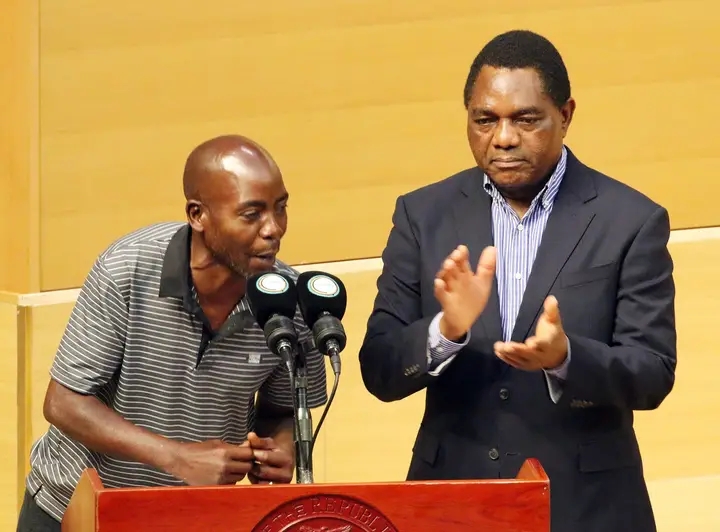
President Hakainde Hichilema’s candid admission that Zambia’s power crisis is giving him “sleepless nights” marked one of his most direct acknowledgments yet of the government’s struggle to restore electricity stability. The remarks, made before UPND party members in Lusaka on Sunday, underscored both the gravity of the energy shortfall and the mounting public frustration it has caused.
The President framed the crisis as a consequence of long-term underinvestment and the country’s heavy reliance on hydropower, which has left the grid vulnerable to climate shocks. “Electricity is one of our biggest outstanding challenges,” he said. “We depended on hydro, and the drought wiped out our generation capacity. This is one subject giving me sleepless nights.”
The 2024–2025 drought — one of the worst in recent decades — has reduced generation at the Kariba and Kafue Gorge power stations, forcing Zesco to implement load shedding of up to 14 hours in some areas. The government has since imported emergency power and prioritized supply to selected economic zones, but shortages persist across residential and industrial consumers.
Hichilema’s tone reflected a mix of apology and resolve. “I’m sorry to a lot of our people who are going through load shedding,” he told party members. “We are working hard to fix what wasn’t done for over 50 years.” The President’s remarks acknowledged the social cost of power rationing, which has disrupted small businesses, traders, and households.
He attributed much of the current crisis to what he described as “historic neglect” of alternative energy investments. “We should have invested in solar long ago, but we didn’t. We also didn’t invest enough in coal; only 300 megawatts,” he said.
In a notable policy update, Hichilema revealed that several major generation projects are under way. The Maamba thermal plant, Zambia’s main coal-fired station, is being expanded to add 300 megawatts of coal and 100 megawatts of solar capacity. “This will bring Maamba to 700 megawatts by next year,” he said.
In Chisamba, Phase 1 of a 100-megawatt solar power plant has been completed, with Phase 2 expected to double capacity to 200 megawatts. Additional investments in solar mini-grids and public–private partnerships are also being explored under the government’s renewable energy framework.
The President emphasized that the government’s approach is not just about short-term relief but structural reform. “We are not just reacting to the crisis, we are building long-term solutions. We’re doing what should have been done decades ago,” he said.
Hichilema’s remarks come as Zambia’s economic outlook faces pressure from reduced industrial output and increased fuel imports to offset power deficits. The Bank of Zambia has warned that continued energy shortages could weaken growth forecasts and raise inflationary risks.
For now, the President’s words signal awareness of a crisis that has cut across politics, business, and public patience. His challenge remains turning plans into visible relief for households that have lived in darkness for months and proving that the sleepless nights at State House can translate into light for the nation.
About The Author
















Leave a comment