

By: Chioma Madonna Ndukwu
With the passing of Pope Francis on Easter Monday, the Catholic Church has entered a pivotal moment, marked by the sede vacante the vacancy of the papal seat.
This marks the beginning of a complex and highly secretive process to elect the next pope, with cardinals around the world now in the spotlight as potential candidates.
The selection will take place in the Vatican’s Sistine Chapel, where eligible cardinals will gather to choose the new spiritual leader of over 1.3 billion Catholics worldwide.
While there is no clear frontrunner, several high-profile cardinals are being discussed as likely successors.
The process is guided by centuries of tradition, but with shifting dynamics in the Church, the outcome remains unpredictable.
As one Vatican insider noted, “This is a moment of reflection and anticipation. The next pope will need to unite the Church, steer it through modern challenges, and continue the mission of Pope Francis.”
From progressive reformists to staunch traditionalists, the candidates represent a wide range of theological viewpoints.
Here is a closer look at the cardinals currently being speculated as strong contenders to lead the Church.
Leading Contenders for the Papacy
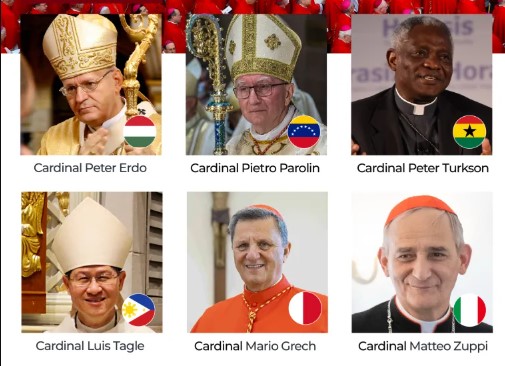
Cardinal Luis Antonio Tagle (Philippines)
Tagle, who currently holds the position of Cardinal-Bishop of San Felice da Cantalice, is widely regarded as one of the most charismatic and internationally recognized figures within the Church.
He has held various roles, including President of the Catholic Biblical Federation.
His commitment to social justice and his ability to connect with diverse communities make him a favorite among those who view the Church’s future through a progressive lens.
“Tagle brings a global perspective and compassion that could redefine the papacy,” one expert commented.
Cardinal Pietro Parolin (Italy)
Serving as the Vatican’s Secretary of State, Parolin has been a key figure in the Church’s diplomatic efforts, particularly in fostering relationships with global powers.
His steady hand and close working relationship with Pope Francis position him as a seasoned leader capable of navigating the complex political and social landscape of the Catholic Church.
“Parolin’s experience with Vatican diplomacy makes him a pragmatic choice for those seeking stability,” said one Vatican source.
Cardinal Péter Erdő (Hungary)
Erdő, who has served as the Archbishop of Esztergom-Budapest for over two decades, is a leading figure among the Church’s conservative wing.
Known for his deep theological insights and commitment to tradition, Erdő’s influence within the Church is significant.
“Erdő’s vast knowledge of Church doctrine and his long leadership experience in Hungary could appeal to those seeking a more traditional papacy,” remarked a senior Church official.
Cardinal Raymond Leo Burke (USA)
Burke is one of the most prominent conservative voices in the Catholic Church. Known for his outspoken views on doctrinal issues, Burke served as Prefect of the Apostolic Signatura and has been an advocate for a return to traditional Catholic teachings.
His leadership style, which emphasizes doctrinal purity, has earned him both passionate supporters and vocal critics.
“Burke’s strong stance on Church teachings has earned him a loyal following, but also controversy,” said a Vatican observer.
Cardinal Matteo Zuppi (Italy)
Archbishop of Bologna, Zuppi has been praised for his ability to foster dialogue and reconciliation within the Church.
His work with the Synod of Bishops, which promotes a more participatory approach to governance, aligns with Pope Francis’ vision for a more synodal and inclusive Church.
“Zuppi’s diplomatic approach and focus on unity within the Church make him a strong candidate,” explained a Vatican insider.
Cardinal Willem Jacobus Eijk (Netherlands)
Eijk, a trained medical doctor and moral theologian, has served as Archbishop of Utrecht since 2007. Known for his conservative views on bioethics and Church teachings, Eijk has been a vocal advocate for the Church’s traditional values.
“Eijk’s deep knowledge of moral theology and his steadfast commitment to Catholic teachings could resonate with those who favor a more conservative approach,” said a colleague.
Cardinal Mario Grech (Malta)
As Secretary General of the Synod of Bishops, Grech has played a key role in guiding the Church’s global consultations and fostering synodal conversations. His leadership in encouraging a more collaborative approach to governance has positioned him as a potential leader for a Church seeking more inclusivity and reform.
“Grech’s experience with synodality and his ability to bring diverse voices together make him an appealing candidate for those who want to see change,” stated a Vatican expert.
Cardinal Peter Turkson (Ghana)
Turkson, a former head of the Pontifical Council for Justice and Peace, has been a champion of social justice, environmental stewardship, and the promotion of integral human development.
His international experience and advocacy for the world’s poor and marginalized have made him a strong contender for those seeking a pope who will address the Church’s social responsibilities.
“Turkson’s focus on human dignity and social issues aligns with the direction Pope Francis has championed,” said a Vatican official.
Cardinal Angelo Scola (Italy)
A seasoned theologian and philosopher, Scola previously served as Archbishop of Milan and Patriarch of Venice.
His intellectual depth and administrative experience give him a unique perspective on leading the Church through both theological challenges and organizational growth.
“Scola is a highly respected theologian who could bring a thoughtful and measured approach to the papacy,” said a senior Vatican figure.
Cardinal Pierbattista Pizzaballa (Italy)
Pizzaballa, who serves as the Latin Patriarch of Jerusalem, brings extensive experience in dealing with the Church’s complex relationships in the Middle East.
His leadership in promoting interfaith dialogue and peace in Jerusalem has earned him admiration from various quarters.
“Pizzaballa’s work in Jerusalem has positioned him as a unique leader with the ability to address global issues affecting the Church,” explained a Church leader.
The next few weeks will be critical as the cardinals prepare for the conclave to elect Pope Francis’ successor. The Catholic Church is at a crossroads, facing challenges both within and outside its walls.
As one Vatican expert remarked, “The new pope will need to confront the shifting dynamics of the Church while maintaining its spiritual mission. It will be a delicate balancing act.”
As the world waits in anticipation, all eyes will be on the Vatican to see which of these cardinals will emerge as the next spiritual leader of the Catholic faithful.
About The Author






Leave a comment